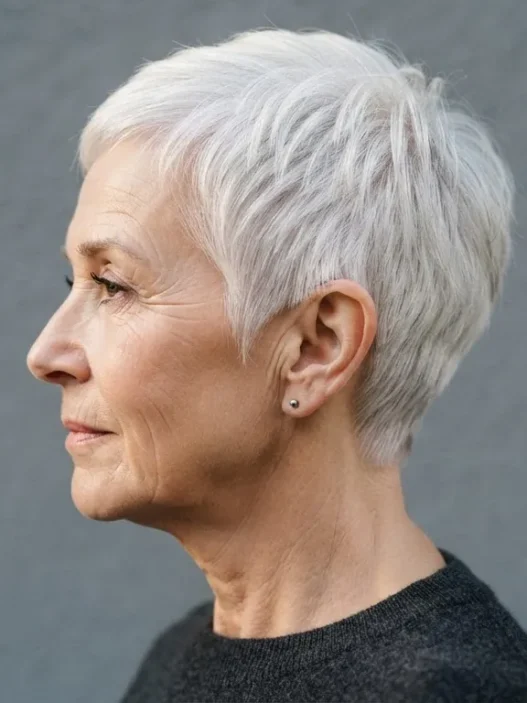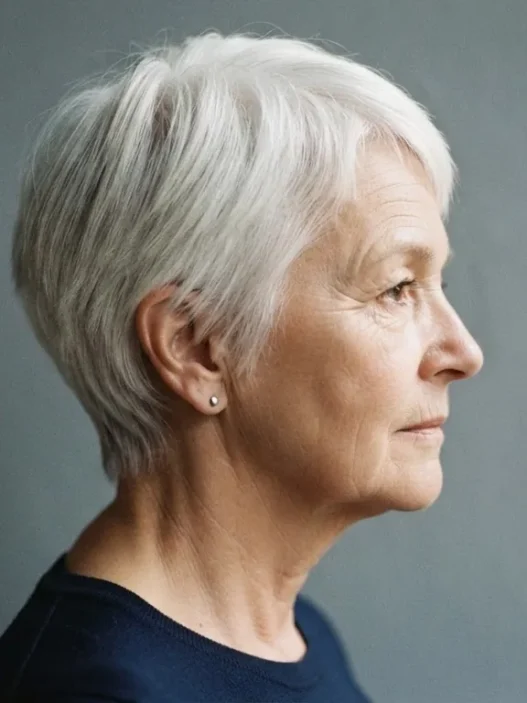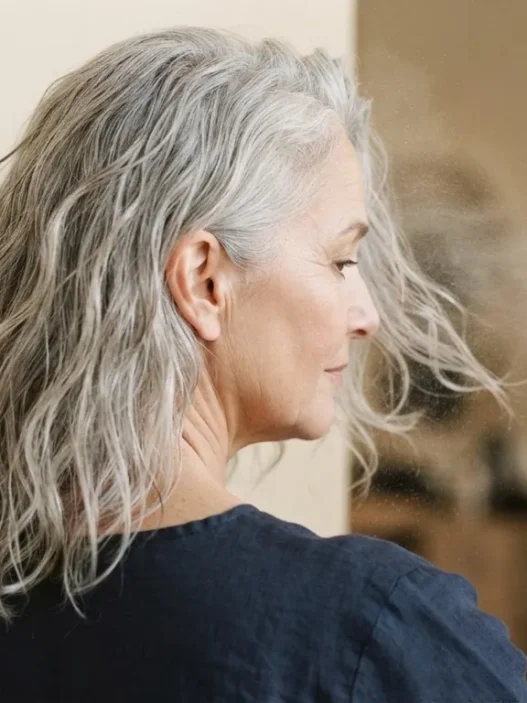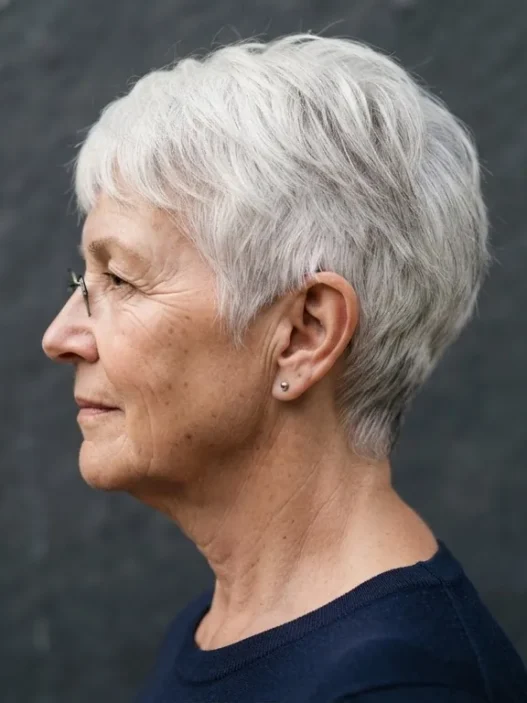








I’ve been obsessing over face-shape-appropriate cuts for a while now, and the long face is the one that trips people up the most — including hairdressers. The instinct is often to add length, go softer, go lighter. But for an oblong or long face shape, the real goal is horizontal width: weight that sits across the face rather than falling straight down past it. At 60, that becomes even more interesting because the hair itself has changed — often finer, often wavier, often beautifully silver — and the cuts that worked at 40 don’t necessarily behave the same way anymore. These 10 cuts are the ones I’d actually shortlist if I were sitting in that chair.
What’s Covered — Jump to Your Cut
- The Cheekbone-Level Fringe That Cuts Vertical Length
- The Blunt Lob That Sits at the Jaw
- The Wave-and-Weight Bob at Chin Level
- The Graduated Bob With a Low Nape
- The Curtain Bang With a Collarbone Layer
- The Side-Swept Fringe on a Mid-Length Cut
- The Rounded Shag With Face-Framing Pieces
- The Blunt One-Length Cut With Soft Ends
- The Textured Lob With Wispy Face-Framers
- The Deep-Side-Part Pixie That Widens the Crown
1. The Cheekbone-Level Fringe That Cuts Vertical Length
This is the big one for long face shapes, and honestly it’s the cut I recommend first every single time. A full or semi-full fringe — not wispy, not heavily thinned — that lands right at the top of the cheekbone or just below the brow immediately breaks the face’s vertical line. The rest of the hair sits at collarbone length or shorter, so the eye reads width before it reads length. The key construction detail: the fringe is cut with very little tapering at the sides, keeping density across the forehead. That horizontal density is exactly what does the work.
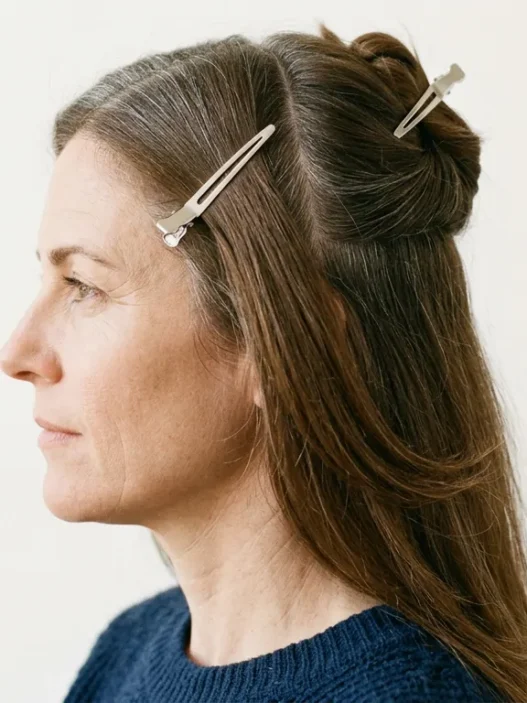
Look at how she’s wearing hers in the photo — the fringe lands precisely at cheekbone level and the waves at the sides push outward rather than down. That’s not accidental. It suits women with fine-to-medium hair best because very thick hair can make a full fringe feel heavy; if your hair is on the coarser side, ask for it to be point-cut underneath rather than blunt-cut. Upkeep is every 4–5 weeks just for the fringe trim, or it starts to drop into the eyes and lose that clean horizontal line.
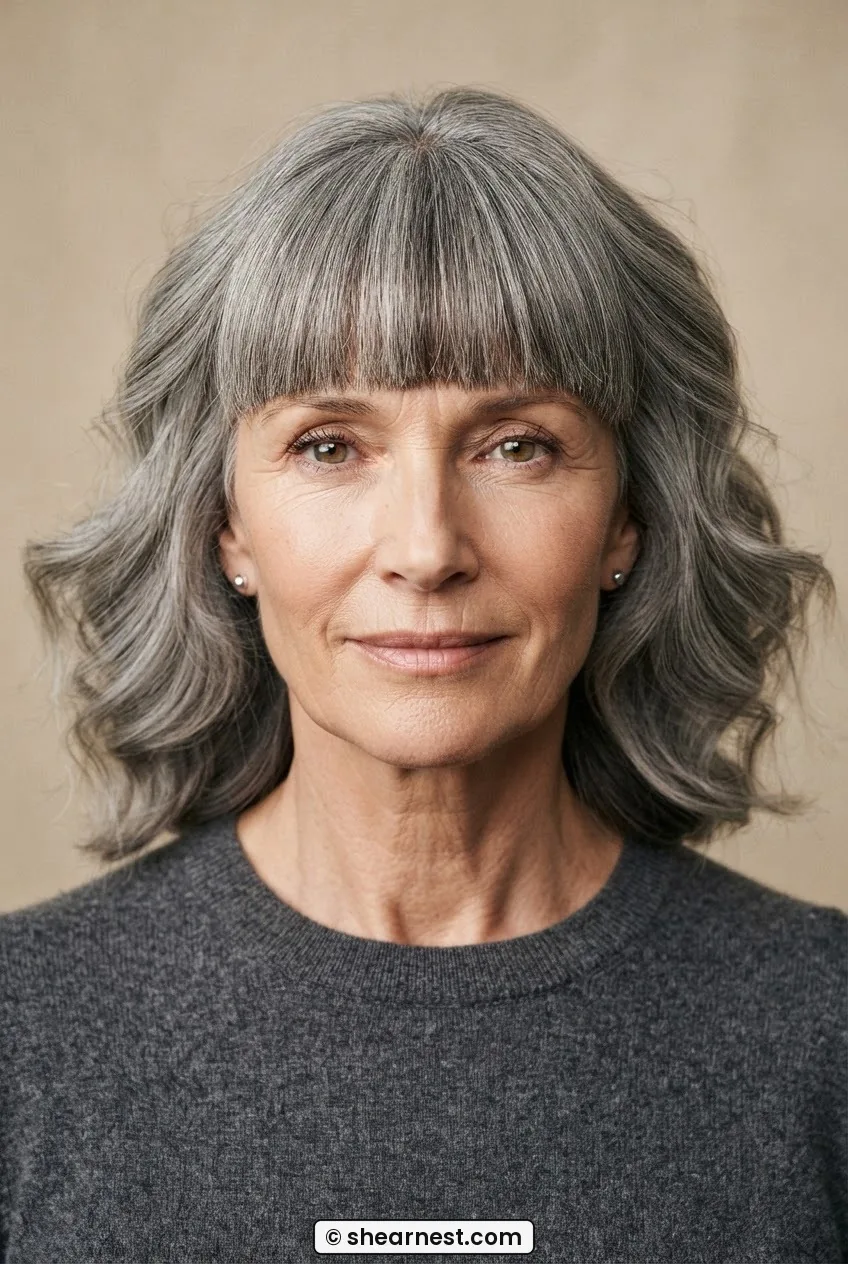
What to say at the chair: “Full fringe landing at cheekbone level, no tapering at the sides, point-cut underneath to avoid bulk. I want it to read horizontal, not curtain-like.”
2. The Blunt Lob That Sits at the Jaw
A lob — or long bob — that ends right at the jawline is one of the smartest structural moves for a long face. The bluntness of the cut creates a shelf of weight that draws the eye sideways. When it’s too layered or too feathered at the ends, that horizontal shelf disappears and you’re back to length again. The weight sits entirely at the perimeter, with minimal interior layering, which means the hair swings outward at the jaw rather than clinging to the neck.
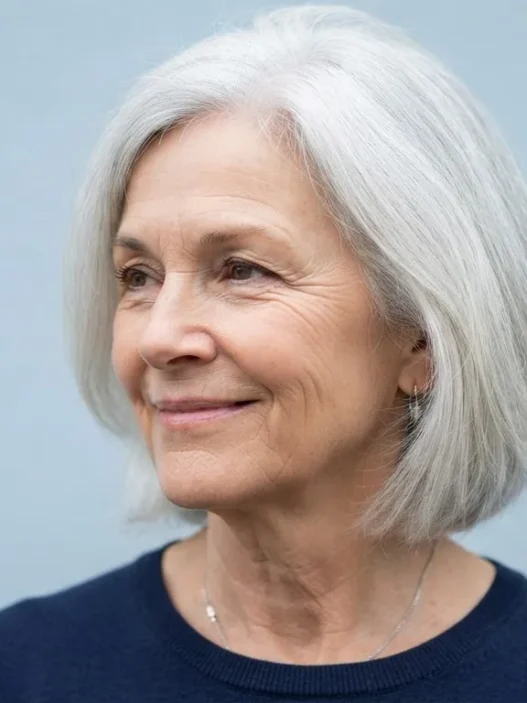
This one is particularly good for straight or slightly wavy hair. If yours is naturally wavy, the wave adds even more width at exactly the right level. She’s got a similar texture to what I’m describing — see how the ends push outward at the jaw rather than tucking in? That’s the blunt perimeter doing its job. For fine hair, I’d actually say this is one of the very best options because the weight line reads fuller than it actually is. For upkeep, you’re looking at every 6–8 weeks to keep the blunt line crisp. You can read more about how cuts behave differently on fine hair in this guide to haircuts for fine hair over 50 — a lot of the same rules apply at 60.
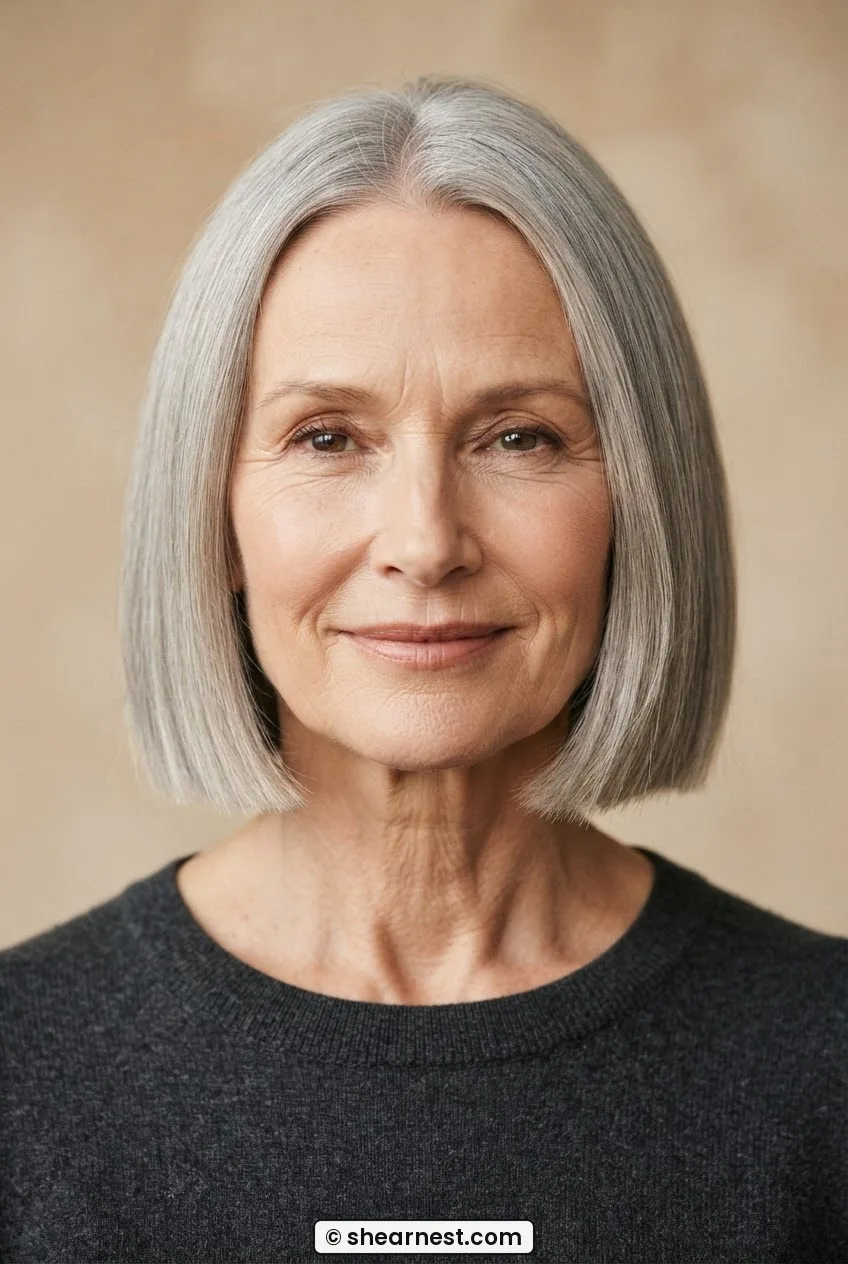
What to say at the chair: “Jaw-length lob, blunt perimeter, minimal interior layering — I want to keep the weight line strong at the ends.”
3. The Wave-and-Weight Bob at Chin Level
This is my personal favourite on grey hair specifically, and I find myself recommending it constantly. The construction is a one-length bob cut to sit at the chin, then styled with a loose wave or set — not a tight curl, not a smooth blowout, but something in between. The wave adds horizontal volume at exactly chin level, which is the widest point you want the eye to travel to on a long face.
This is my personal pick for silver and grey hair at 60. The texture of grey hair actually holds a soft wave beautifully without product — the wave adds width right at chin level, and the chin is exactly where you want the horizontal emphasis to land on a long face. I’ve seen this cut transform the proportion of a face in one appointment.
The cut itself is kept one-length with no graduation, which means the wave sits outward rather than curling under. On grey or silver hair — which often has a slightly coarser, drier texture than pigmented hair — the wave tends to hold naturally without much product. Upkeep is every 6 weeks to keep the chin-level line intact. If you let it grow past the jaw, the proportion shifts and you lose the width effect.

What to say at the chair: “Chin-length one-length bob, no graduation, I want to wear it with a soft wave — cut it so the ends push outward rather than curling under.”
4. The Graduated Bob With a Low Nape
Different beast from the blunt bob entirely. Here, the graduation runs from a low, close nape up to a longer front, with the longest point landing at or just below the earlobe. The stacking at the back creates volume at the crown and back of the head — which, on a long face, adds roundness to the overall silhouette rather than elongating it further.
The front pieces should be long enough to frame the cheekbones and sit forward. This is the cut for women with thicker hair because the graduation manages bulk brilliantly. On fine hair it can fall flat at the back — if that’s you, go for the blunt lob instead. Upkeep is 5–6 weeks. It’s also worth knowing that this cut sits quite differently at 60+ because the nape hairline often becomes finer with age — your stylist should check that before stacking too tightly.
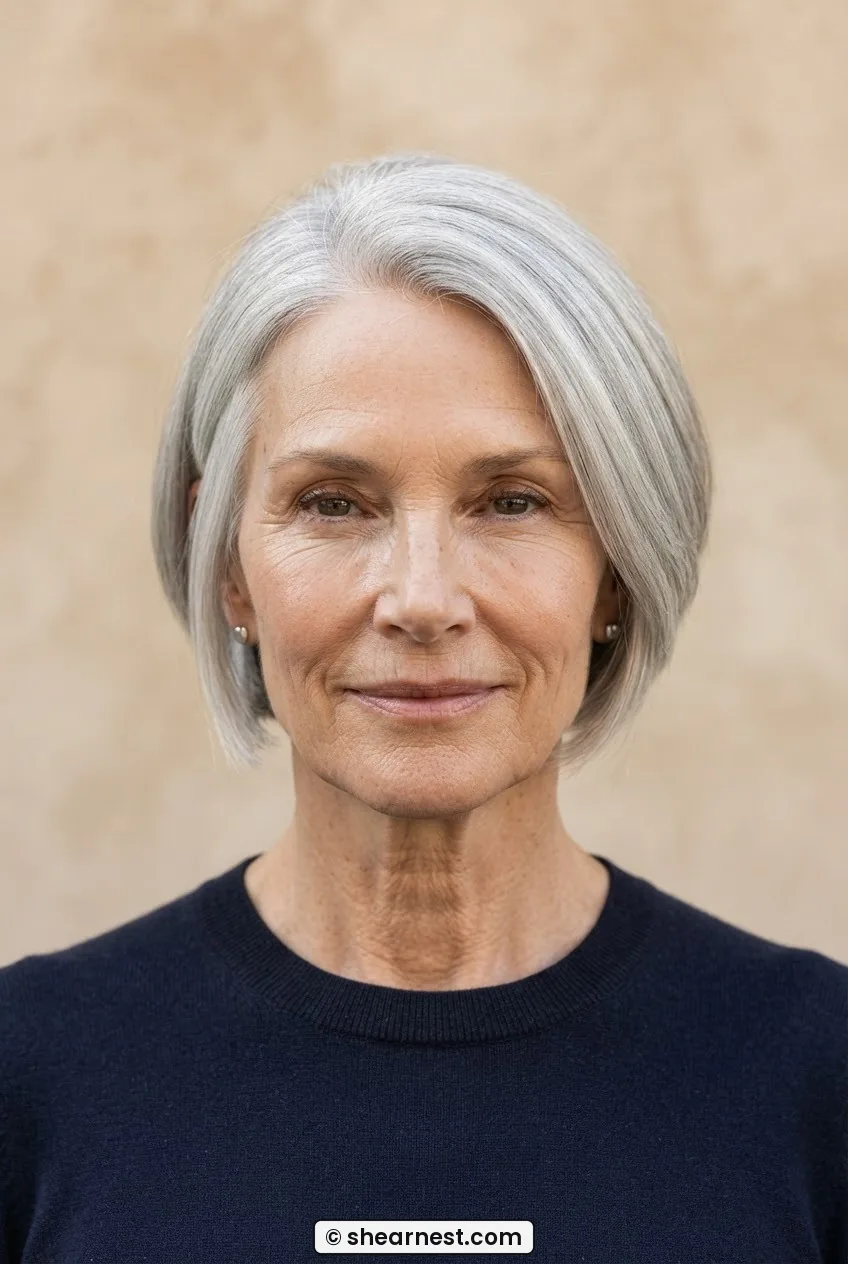
What to say at the chair: “Graduated bob with a low nape, longest point at the earlobe, I want the front pieces to sit forward past the cheekbone.”
5. The Curtain Bang With a Collarbone Layer
Curtain bangs are having a genuine moment — not just for younger women, not just a trend — they genuinely solve a real problem for the long face shape. The parting splits in the middle and the two sides sweep outward past the temples, which creates a horizontal line across the upper third of the face. Pair that with hair that’s been layered to sit at collarbone level, and you get two horizontal breaks: one at the forehead, one at the collarbone. Two horizontal lines on a vertical face is a very clever structural trick.
The layers should be soft — not choppy — and long enough that they blend seamlessly. This is not a layered shag; it’s a more polished version. It suits wavy and straight hair equally well. If you’re navigating the texture changes that come with going grey, this is a forgiving cut because the layers respond well to natural texture. Upkeep sits around every 7–8 weeks for the layers, with a bang trim at about 4 weeks. Understanding how wavy hair interacts with these kinds of layers is useful too — there’s a really good breakdown in this article on wavy haircuts for women over 50 that covers similar ground.

What to say at the chair: “Curtain bangs sweeping past the temples, collarbone-length layers — keep the layers soft and long, not choppy.”
6. The Side-Swept Fringe on a Mid-Length Cut
For anyone who doesn’t want the commitment of a full fringe but still needs to interrupt the vertical line at the forehead, a side-swept fringe on a mid-length cut is the compromise that actually works. The fringe sweeps across the forehead — starting from a side parting — and sits just above or at the brow. The sweep creates a diagonal that reads as width. It’s a more understated version of the full fringe effect.
The rest of the cut sits at shoulder length with soft layers, which keeps the overall silhouette from dragging the face longer. This suits all hair types — straight hair gets a clean diagonal sweep, wavy hair gets a more relaxed, slightly tousled version that’s honestly just as effective. The main thing to watch: if the sweep is too long (past the nose), it stops reading as a horizontal element and becomes a curtain. Keep it brow-length and you’re golden. Maintenance is lighter than a full fringe — every 6–8 weeks is usually enough.
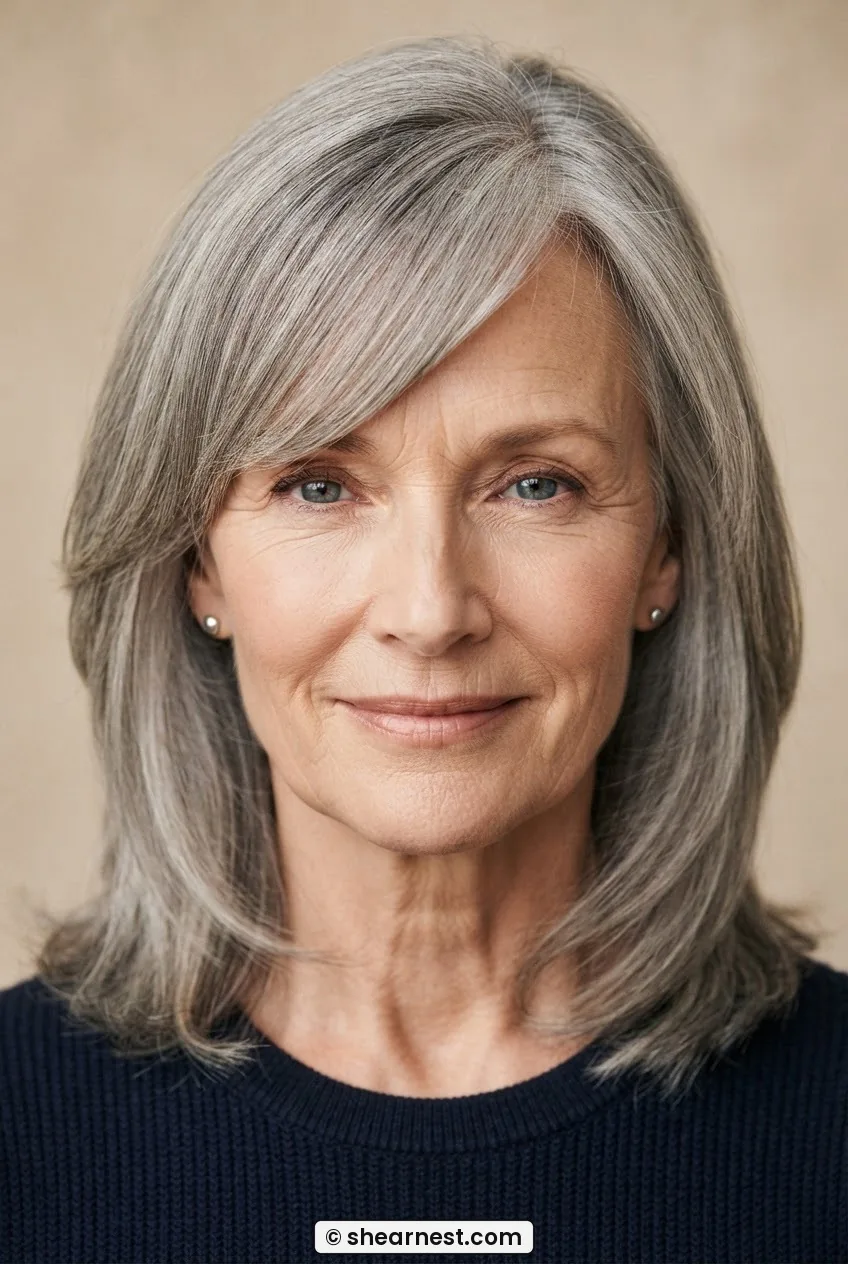
What to say at the chair: “Side-swept fringe from a side parting, brow-length — not past the nose. Soft layers through the length at shoulder level.”
7. The Rounded Shag With Face-Framing Pieces
The shag has been reclaimed and reworked for women at every age, and when it’s done right for a long face, it’s genuinely impressive. The key word here is rounded — the layers follow a rounded silhouette rather than falling straight down. Face-framing pieces at cheekbone level push outward, and the crown layers are kept slightly shorter to add height without adding length to the sides.
This construction works against a long face because the weight is distributed horizontally at multiple levels — cheek, jaw, collarbone — rather than landing in one straight fall. She’s wearing it beautifully in the photo; notice how the face-framing pieces angle outward at the cheekbones rather than lying flat. That’s a stylist who understands the brief. This is a high-texture cut that suits wavy and curly hair best. Straight hair will need some styling to achieve the volume, but it’s doable. Upkeep is every 6–8 weeks to stop the layers growing out too long and losing the roundness.
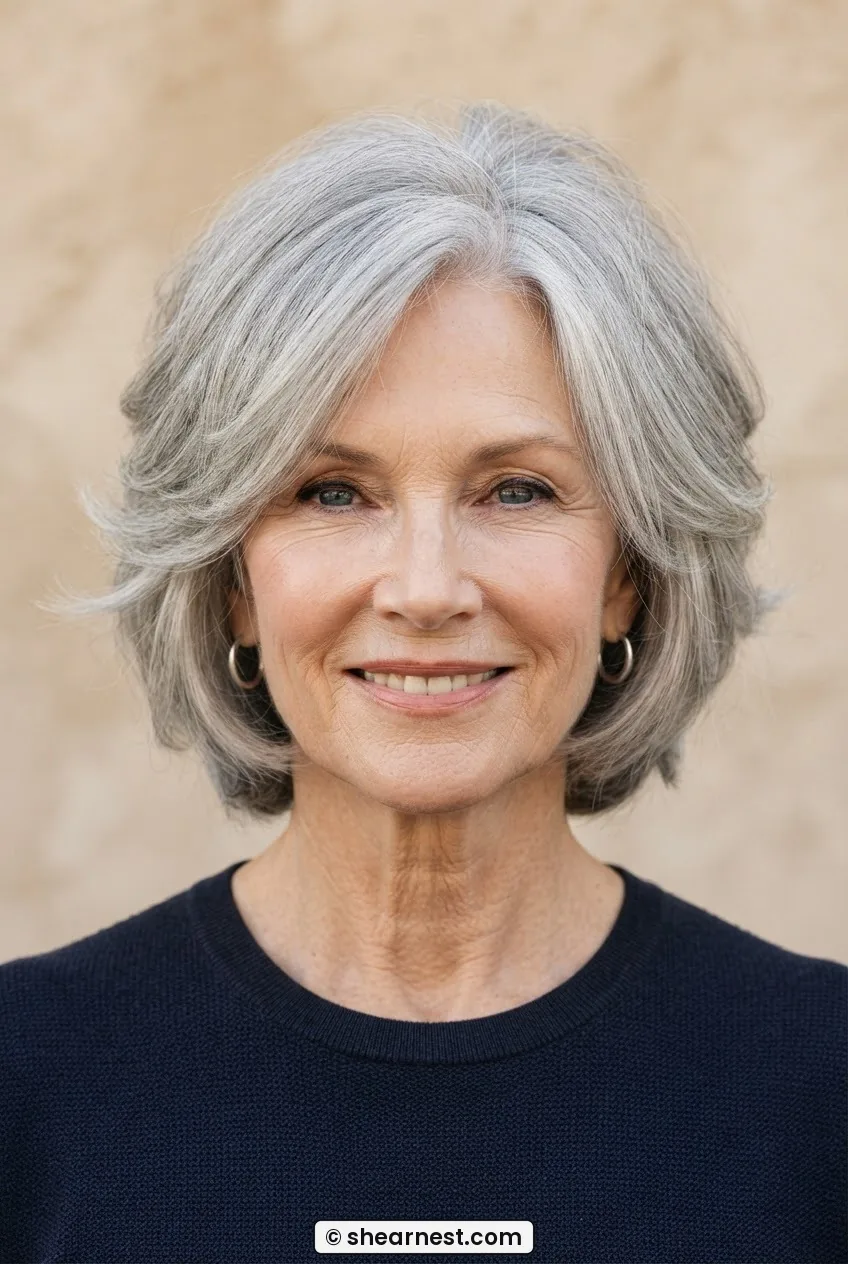
What to say at the chair: “Rounded shag — I want the face-framing pieces to sit at the cheekbone and angle outward, not flat against my face. Keep the silhouette rounded.”
A Stylist Who Gets the Long Face Brief
8. The Blunt One-Length Cut With Soft Ends
This one surprises people. A one-length cut — no layers, no graduation — sounds like it would make a long face look longer. But when it’s cut to exactly the right length (chin to just below the jaw) and finished with softly point-cut ends rather than razor-hard ones, it reads as a horizontal band across the lower face. The soft ends prevent it from feeling severe while keeping the weight concentrated at one level.
The critical thing here is length. Too long — say collarbone or beyond — and yes, it elongates. But at chin-to-jaw level, it frames and widens. It’s a deceptively simple cut that is almost entirely about precision. Best for straight or very slightly wavy hair where the natural texture will hold the line. If yours is very wavy or curly, the ends won’t sit as a clean horizontal line unless you style them that way every day — and that’s a lot of upkeep. For straight-haired women over 60, I’d put this in the top three. There’s also some genuinely useful thinking about how straight hair behaves at this age in this piece on straight hair cuts for women over 50.
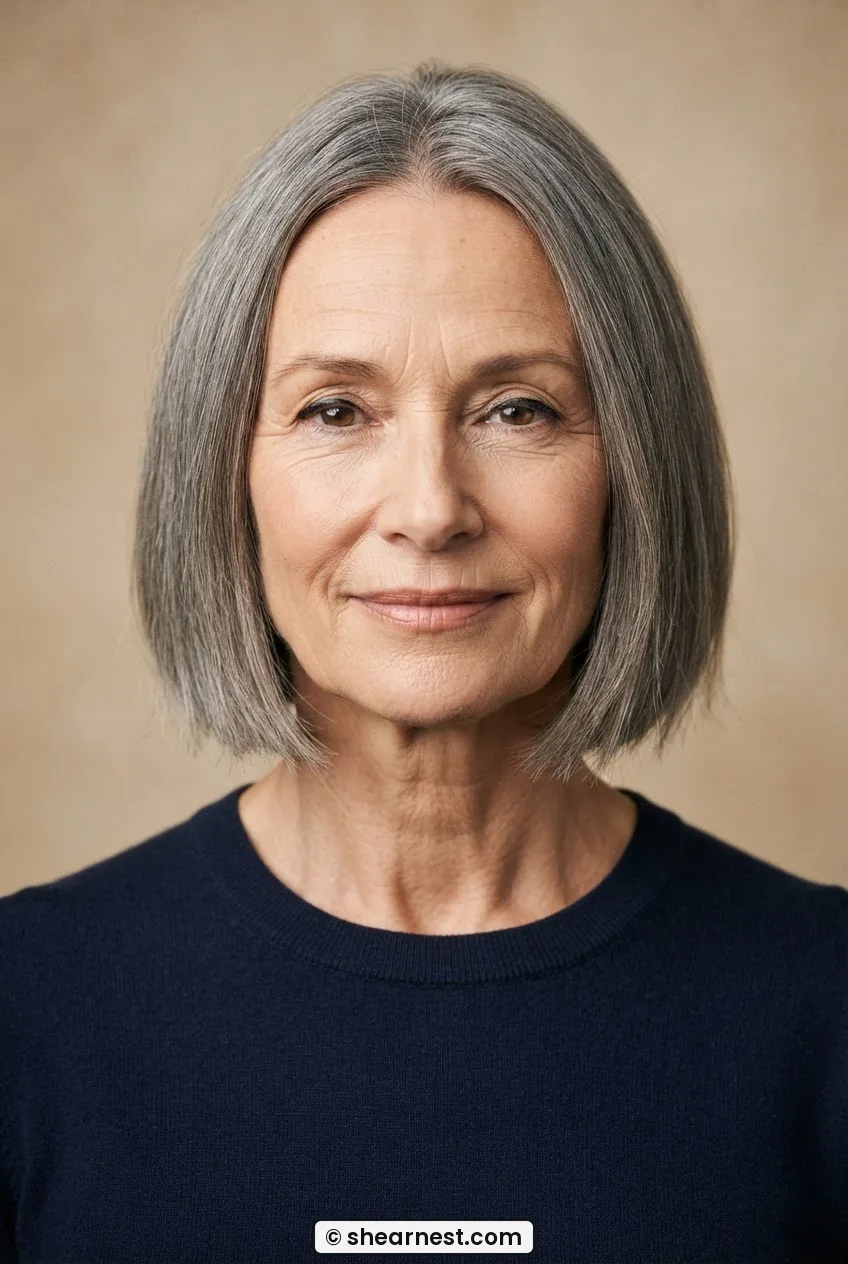
What to say at the chair: “One-length, no internal layers, chin to jaw level — finish the ends with point cutting, not a blunt razor line.”
9. The Textured Lob With Wispy Face-Framers
Different from the blunt lob in a meaningful way — this one has interior texture through the mid-lengths (not the ends) and a set of wispy face-framing pieces that start at the cheekbone and blend into the length. The face-framers don’t add width the way a fringe does; instead they soften the jaw area and draw attention upward and outward. The length sits at collarbone level.
The texturing through the mid-lengths is done with a razor or by slicing, never with chunky layers — the goal is movement, not bulk. On grey hair this is particularly effective because grey hair often has natural texture and body that responds brilliantly to this technique. It’s also the most forgiving cut on this list for grow-out — the wispy pieces and internal texture mean it looks intentional even at 10 weeks past the appointment. That said, 8 weeks is still my recommended refresh window to keep the face-framing pieces from getting too long.

What to say at the chair: “Collarbone lob with razor-texturing through the mid-lengths and wispy face-framers starting at the cheekbone — no chunky layers.”
10. The Deep-Side-Part Pixie That Widens the Crown
The shortest option on this list, and the one that takes the most conviction — but when it’s right, it’s really right. A pixie with a deep side parting works on a long face because the sweep of hair across the top of the head creates horizontal width at the crown, while the short sides prevent any downward length. The deep parting is structural: it pushes volume to the heavier side of the head, which reads as width.
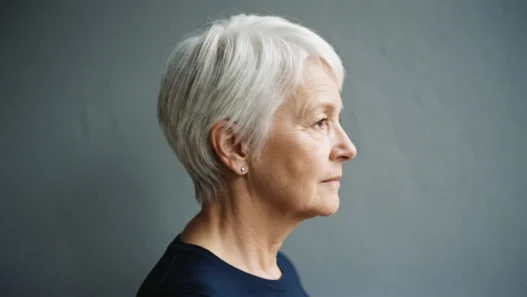
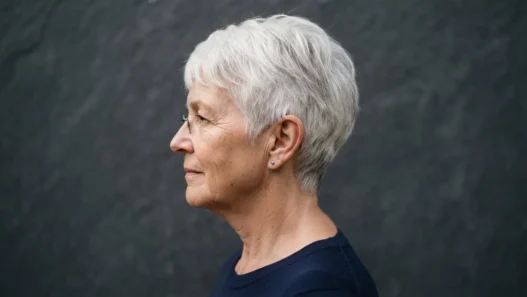
The construction matters a great deal here. The top section needs to be kept longer — about 2–3 inches — so there’s enough length to sweep. The sides should be tapered rather than buzzed, which keeps it soft. At 60, a tapered nape also tends to suit the hairline changes that happen with age better than a hard clipper line. For women who’ve been reading about pixie options for women in their 70s too, there’s a useful companion piece on hair styles for women over 70 that covers how short cuts continue to evolve. This cut suits all hair types but particularly shines on thick or coarse hair that would otherwise be heavy in longer styles. Upkeep: every 4–5 weeks. It’s the highest-maintenance cut on this list, but many women say it’s also the easiest to style daily.
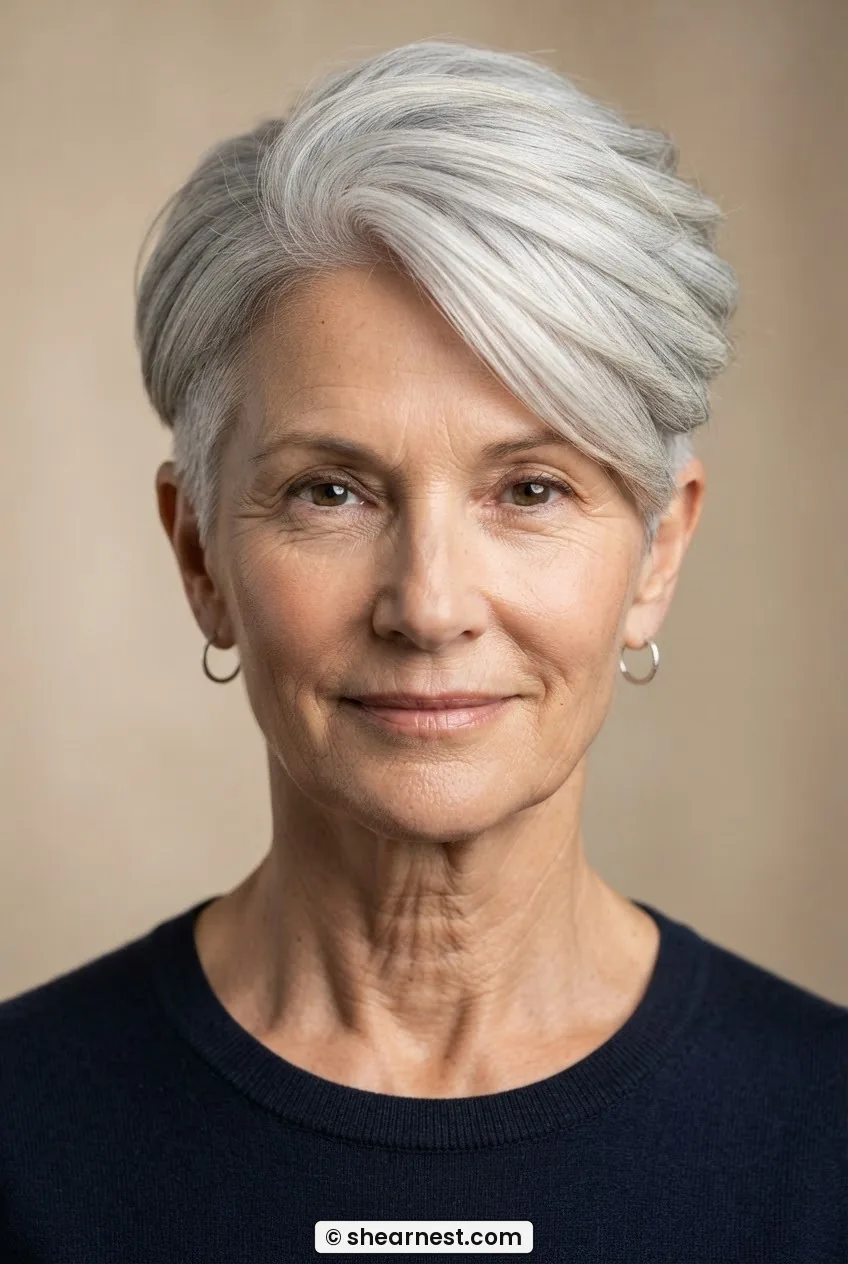
What to say at the chair: “Deep side-part pixie, 2–3 inches on top to allow for a sweep, tapered sides — I don’t want a hard clipper line at the nape.”
Questions I Get Asked About This
Does a long face shape change much by the time you’re 60?
It does, subtly. The face can actually appear slightly longer as the cheeks lose some volume with age and the jawline softens. That makes the horizontal-emphasis principle even more important at 60 than it was at 40. The good news is that softer jawlines actually respond really well to chin-length cuts because the weight of the hair at that level creates definition where the face has relaxed.
Can I still wear my hair long if I have a long face shape?
Yes, but with strategy. Very long hair on a long face typically works better when it has significant width through the mid-lengths — think big waves or curls — rather than falling straight. A strong fringe at the top also helps counterbalance the length below. If you want to keep length, committing to a fringe is probably the single most effective structural move you can make. For context on how oval and long faces differ in what lengths work, this piece on oval face hairstyles for women over 50 makes the distinction well.
What if my hair is both fine and long-face — which cut is safest?
The blunt jaw-length lob (cut 2) is my honest answer. The blunt perimeter creates the illusion of more density than you actually have, and the jaw-length placement adds width exactly where you need it. It’s the cut with the best return on investment for fine hair on a long face at any age. Avoid heavy interior layers — they thin fine hair further and remove the very weight line that does the shaping work.
Are fringes high-maintenance at 60?
They’re the highest-maintenance element on this list — a trim every 4–5 weeks is non-negotiable if you want the horizontal line to keep doing its job. But many women at 60 actually find a fringe simpler to style day-to-day than complex layering, because it requires very little daily effort once it’s the right length. The maintenance and styling question is worth asking your stylist before you commit — some fringes on fine grey hair need a specific blowdry technique to sit flat.
Does hair colour affect how a cut reads on a long face?
Absolutely. Lighter colour at the sides of the head adds visual width, which supports most of the cuts on this list. Going darker through the centre and lighter at the sides is a colouring technique that mirrors exactly what the cuts are doing structurally. It’s worth having that conversation with your colourist at the same appointment. You can find a good overview of face-framing highlight placement that covers how the lightness interacts with face shape specifically.
Honestly, all ten of these cuts have one thing in common: they’re making a structural argument for width. Some make it loudly — the full fringe, the blunt lob — and some make it quietly, like the textured lob with its wispy face-framers. Pick the one that matches your hair texture and your appetite for upkeep, bring a photo if you can, and use the “what to say at the chair” lines I’ve given you so the brief lands clearly. You deserve a cut that was actually designed for your face. These were.