






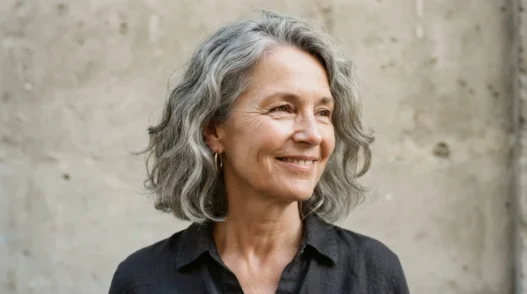
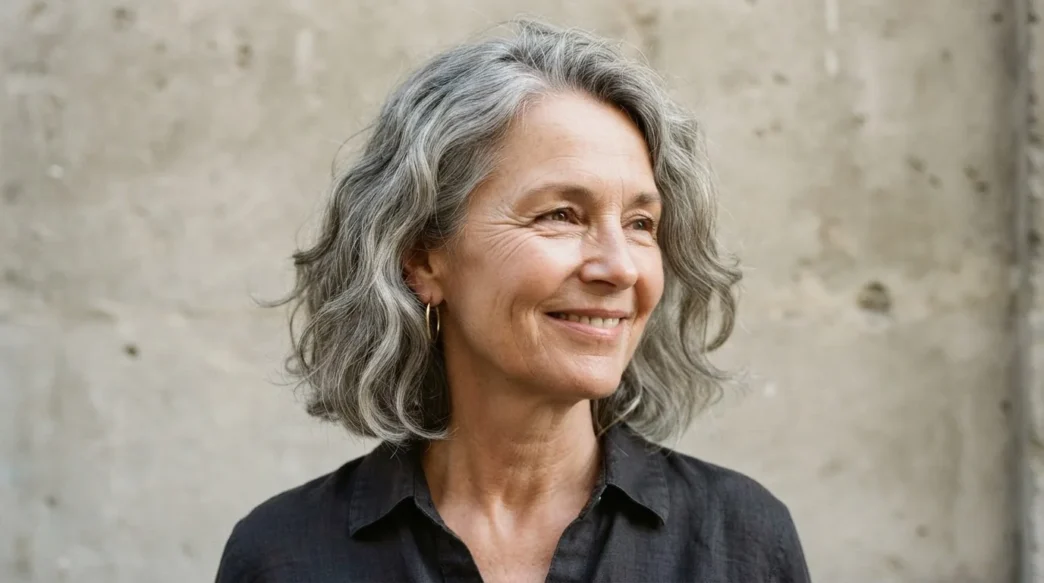
She came in with a printed photo — a sleek, blunt bob, chin-length, perfectly geometric, the kind you’d see on a woman half her age. She had a strong jaw, gorgeous bone structure, and she was sixty-three. I took one look at the photo and knew we were about to have an honest conversation. I’ve been having that same conversation, in different forms, for over two decades. And somewhere along the way, I completely changed what I tell women who have a square face shape and want a flattering haircut after sixty.
The Photograph Problem
The photo problem is this: women bring in images of cuts that work beautifully on the woman in the photo — and then we try to replicate them without accounting for the fact that face shape, skin, and jaw structure all shift over time. A blunt chin-length bob on a forty-year-old with a square jaw sits differently than the same cut on a woman in her sixties. Not better or worse. Just differently. And pretending otherwise is where stylists get it wrong.
The blunt bob is the biggest culprit. For a square face shape, the conventional wisdom has always been: soften the jaw, add movement, avoid anything that ends at the widest point of the face. And that advice isn’t wrong — it’s just incomplete. Because a blunt hemline that hits exactly at the jaw doesn’t just emphasize the jaw’s width. At sixty-plus, it also bisects the face at a point where the skin has softened, and that horizontal line does absolutely nothing for anyone.
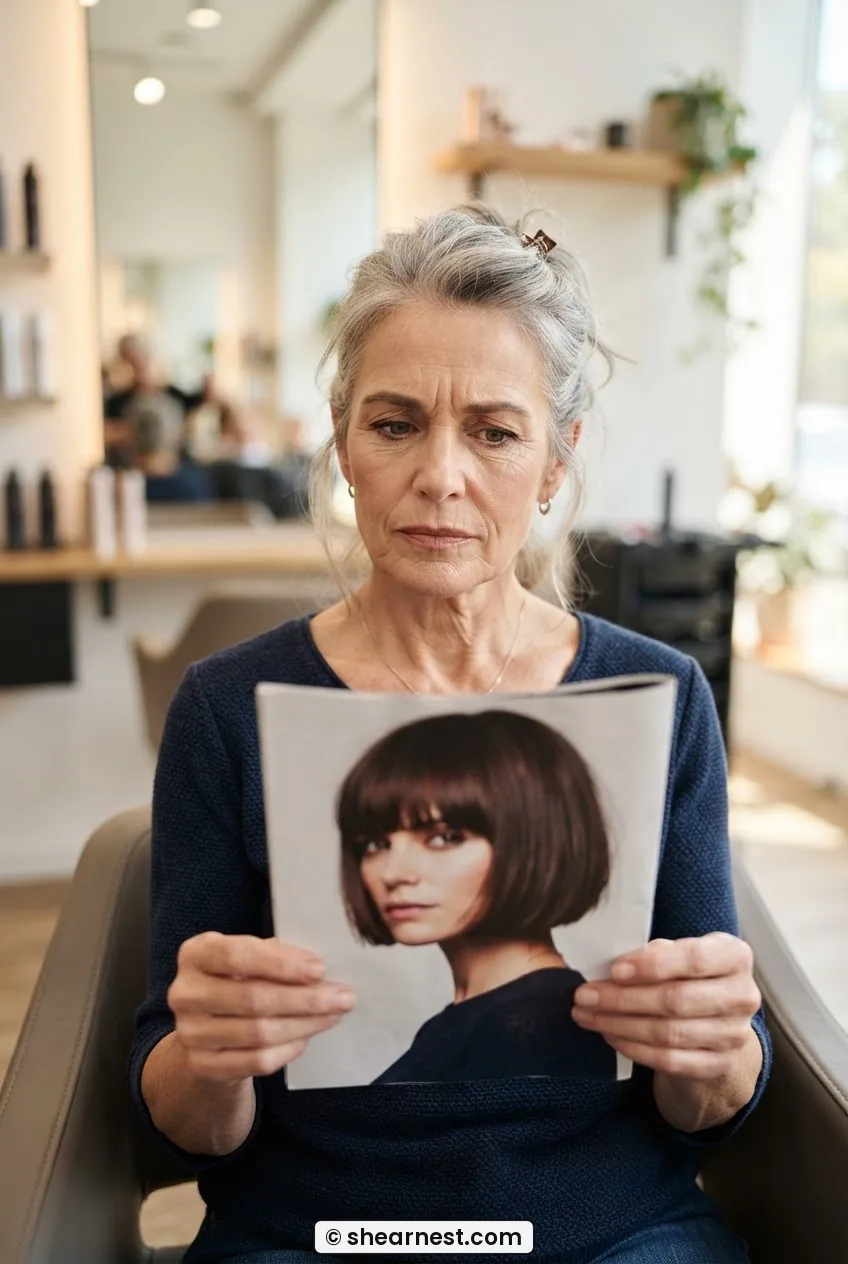
I’ve watched this play out dozens of times. A woman asks for what worked on her in her forties. We do it. She goes home uncertain. She’s not wrong to feel uncertain. The cut that worked then isn’t wrong now — but it may need adjusting. The photograph is from a different chapter.
Why the Perimeter Matters More Than You Think
When I talk about perimeter, I mean where the hair ends — and more specifically, what that endpoint does against the face and neck. For square-jawed women, the perimeter is everything. It’s the thing that either works with the jaw or fights it.
Here’s the mechanism: a square face has strong horizontal lines — a wide forehead, a wide jaw, angular corners. Hair that ends in a straight horizontal line — especially at jaw level — reinforces those horizontals. It essentially draws a box. What breaks that up? Anything that introduces a diagonal or a curve. A slight angle in the hemline. Layers that fall in different directions. Waves that move across the jaw rather than sitting parallel to it.
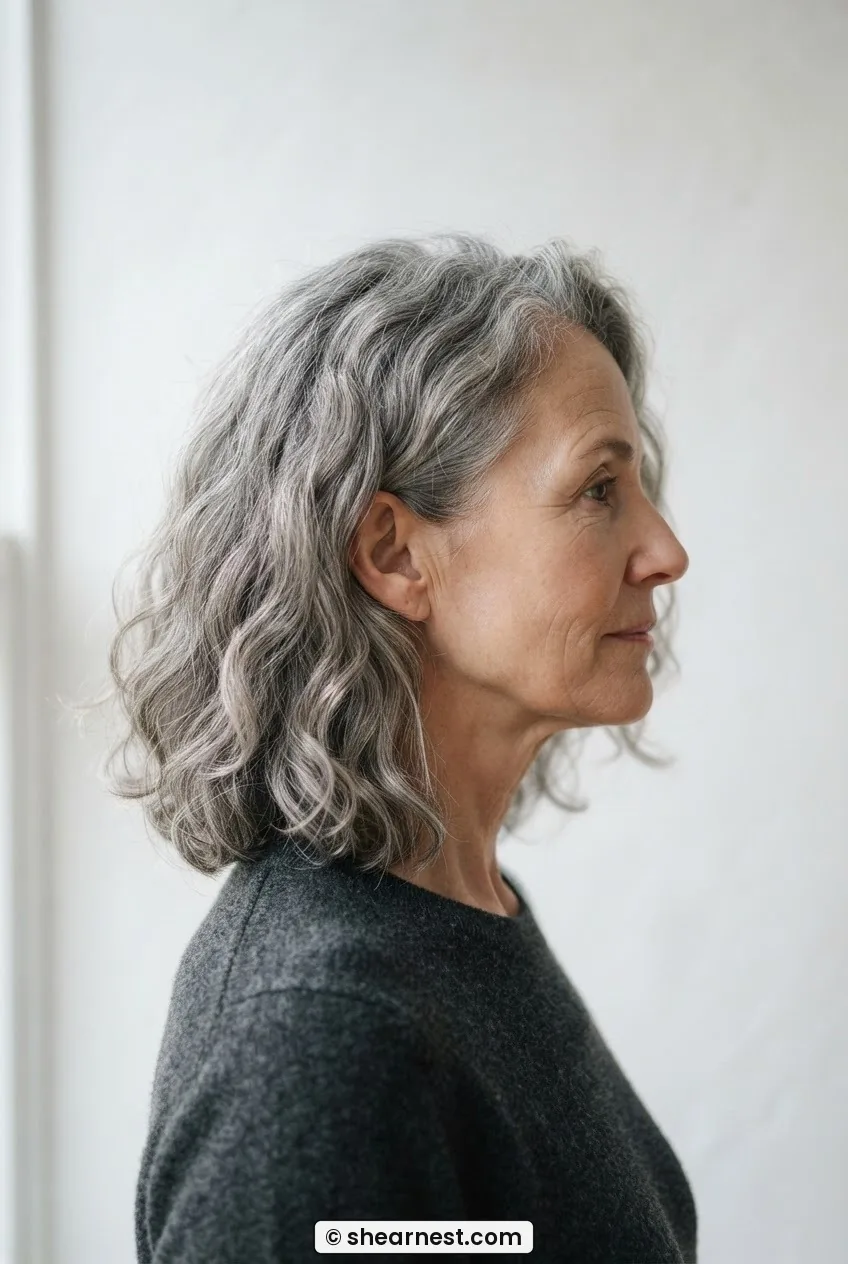
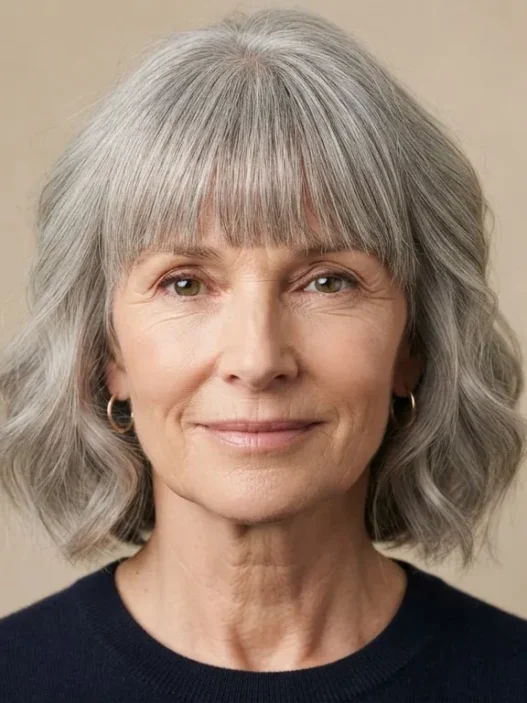
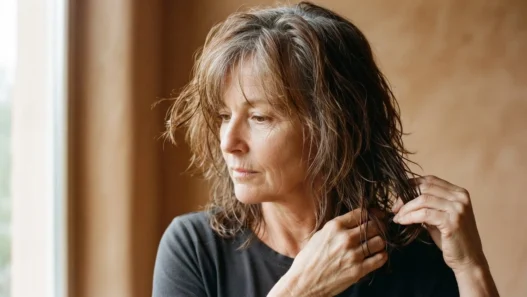
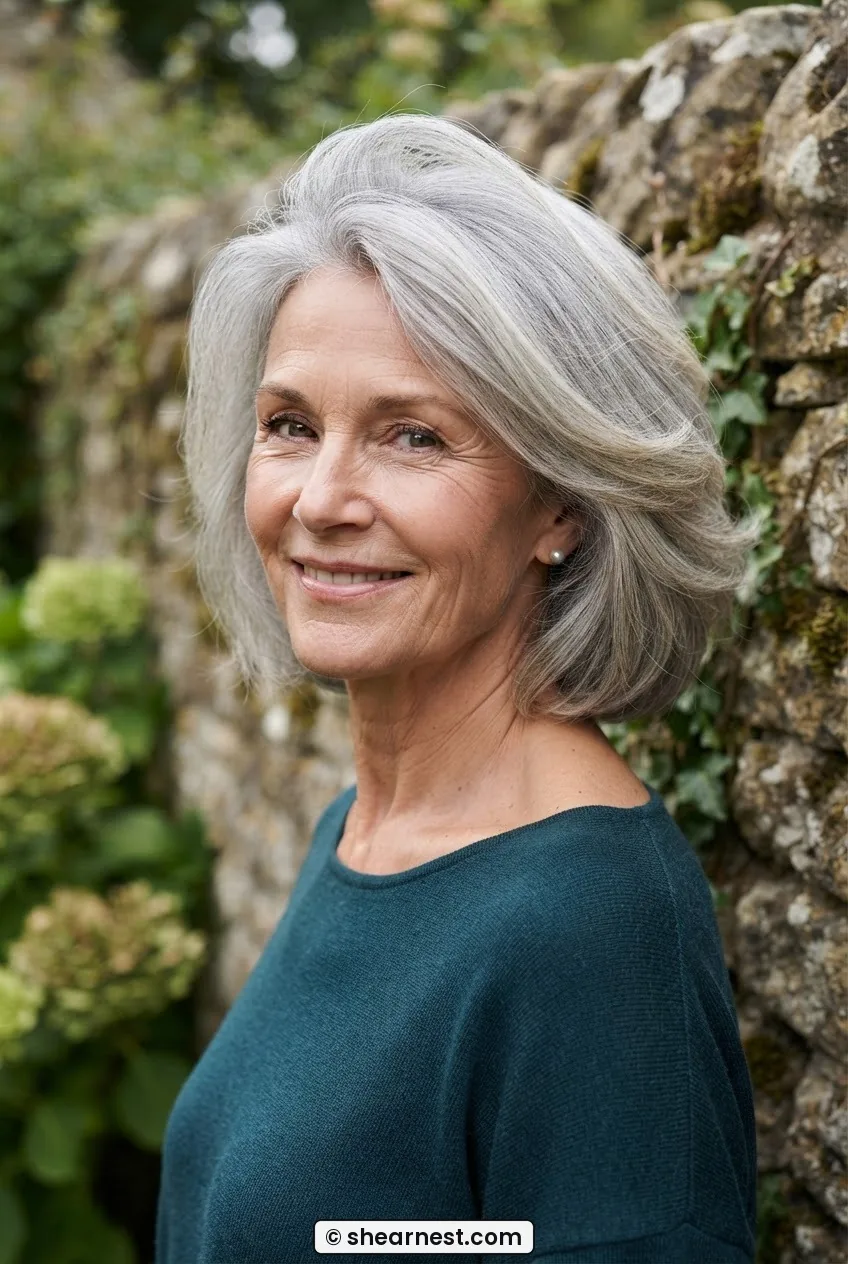
Look at how she’s wearing hers in this photo — the waves hit right at her jaw, but because the texture breaks the line, there’s no hard edge. That softness is doing all the work. That’s exactly what I mean. A straight-cut hemline at the same length would feel completely different. Heavier. More angular. The wave essentially dismantles the box.
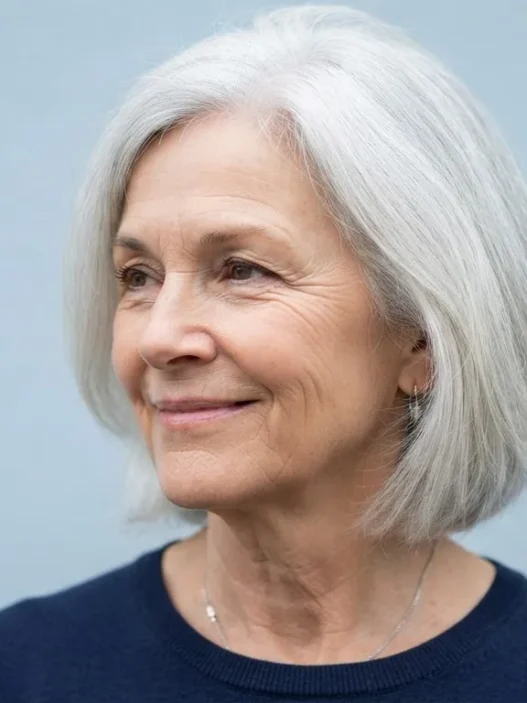
This is why I’m obsessed with the lob — the long bob, sitting anywhere from just below the jaw to an inch above the collarbone — for women over sixty with strong jaw structure. The length clears the jaw without abandoning it. And when it has any movement at all — a slight bend, a soft wave — it does the work of a much more complicated cut. You can read more about how length interacts with face shape in my piece on oval face hairstyles for women over 50, which covers similar perimeter principles from a different angle.
What Age Actually Does to a Square Face
I’m going to say this plainly because not enough people do: a square face after sixty is not the same structural problem it was at thirty. And I mean that in a good way.
The bone structure doesn’t change. But the soft tissue does. The jaw that felt almost severe at forty has often softened at the corners by sixty. The angles are still there — you can still see them — but the skin at the jowl area, and the slight redistribution of facial volume, means the jaw reads differently. It’s less sharp. It can sometimes look closer to a soft rectangle than a hard square. That changes what the hair needs to do.
At thirty, the advice was all about camouflage — hide the corners, create an illusion of oval. At sixty, I find myself working with the structure more than against it. A strong jaw at this age is an asset. It photographs beautifully. It holds the face up. Working against it — trying to soften it completely — can paradoxically make the face look heavier, not lighter.
This matters a lot for how I think about volume placement, too. Volume above the ears and crown — something stylists have always recommended for square faces to balance width — still applies. But now I’m also thinking about what the hair does at the neck and jawline in terms of weight. Too much volume there drags everything down. Too little and the jaw floats without context. It’s a balance that gets more interesting, not less, the older a client gets. If you’re navigating similar shifts in how your hair behaves with age, my post on straight hair cuts for women over 50 gets into the weight and volume question specifically.
What I Changed My Mind About
For years, I told women with square faces to avoid short cuts — specifically anything above the jaw. My reasoning was standard: a pixie or a very short bob would expose the jaw fully and leave nothing to soften it. I believed this. I repeated it constantly.
I was wrong. Or at least, I was too absolute about it.
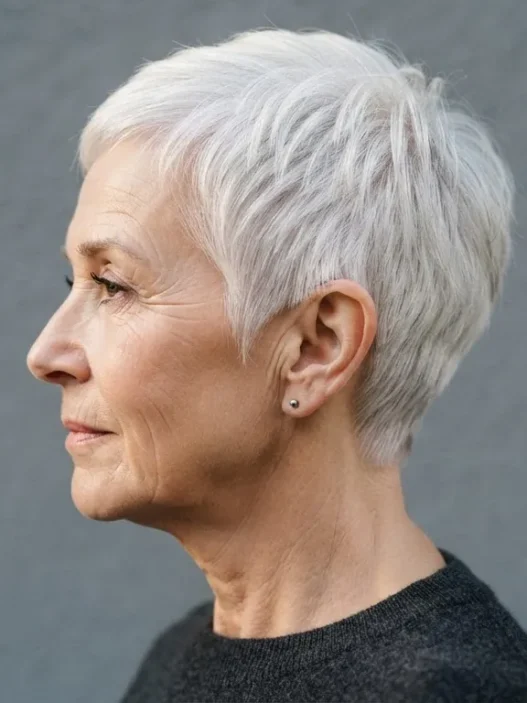
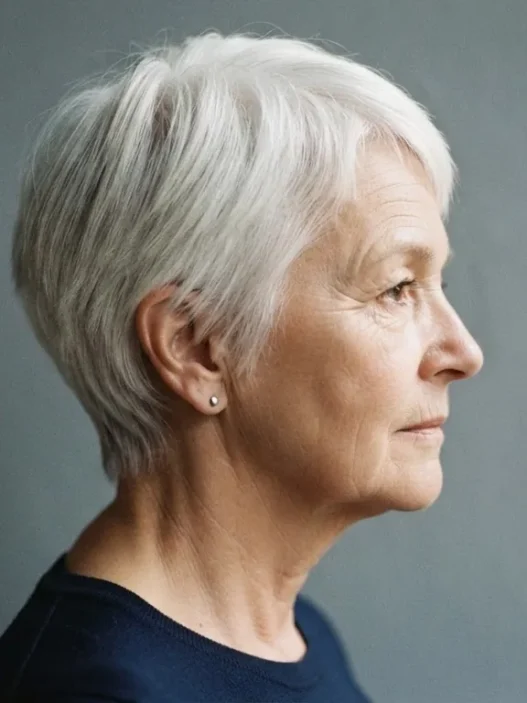
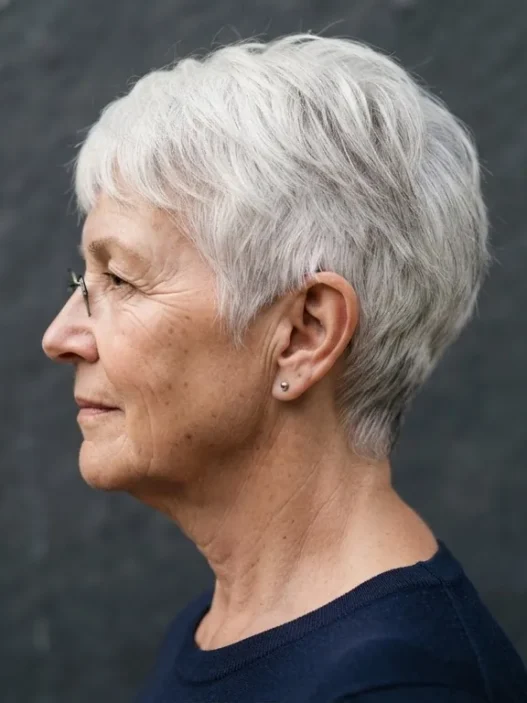
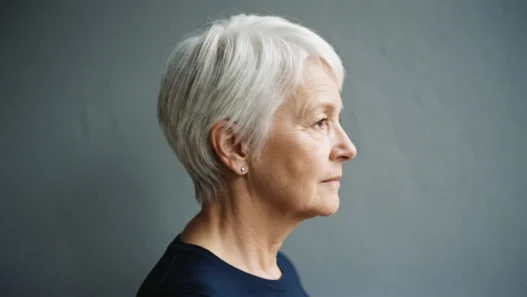
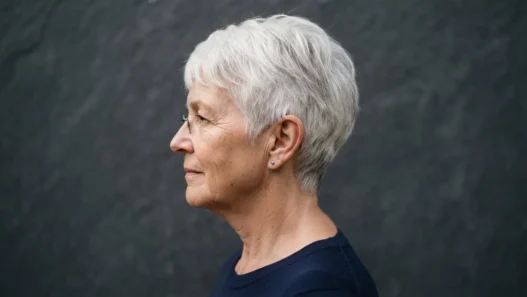
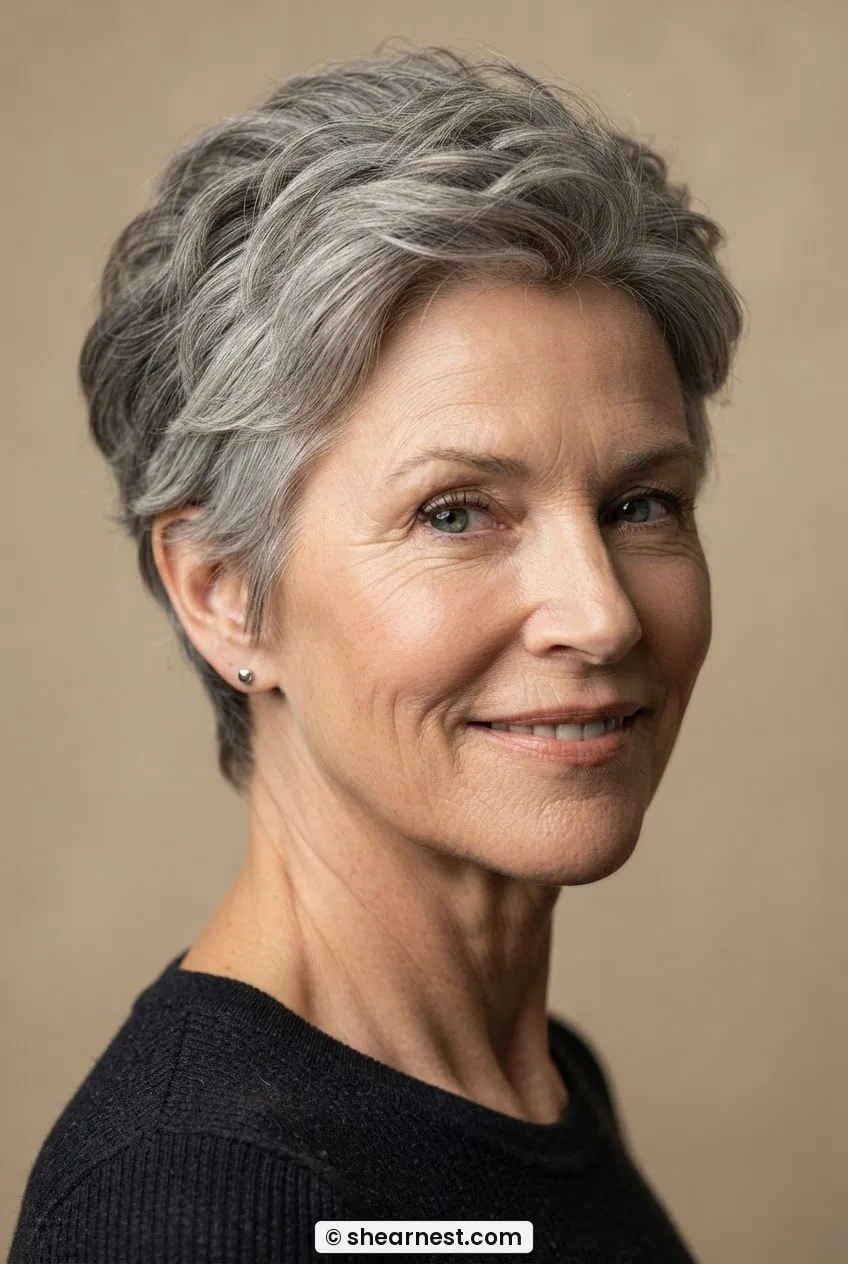
What I’ve seen in practice — particularly with women in their sixties and seventies — is that a well-cut pixie or a short textured crop can work extraordinarily well on a square face. Here’s why: when hair is very short, the jaw is visible regardless. Trying to hide it stops being the point. Instead, the cut becomes about what’s happening at the crown, the temples, and the nape. A pixie with volume through the top and soft texture at the sides actually draws the eye upward, not outward. The jawline becomes a base rather than the focal point. And — and this is the part I underestimated — on a woman over sixty with silver or grey hair, a short cut has a sharpness and elegance that simply doesn’t read as harsh. The grey softens it. The face’s own natural softening meets the cut halfway.
I still reach for the lob as my default recommendation for a haircut on a square face after 60. But I no longer dismiss shorter options the way I used to. Context matters. Lifestyle matters. How a woman carries herself matters. And frankly, a confident woman in a well-executed pixie looks better than a hesitant woman in the “right” cut. That’s not a styling tip — it’s just true. For those thinking shorter, my piece on haircuts for fine hair over 50 has a lot of practical detail on making short cuts work when density is also a factor.
The Cuts Worth Asking For
These are the specific cuts I come back to again and again for women with square faces at sixty and beyond. Not a rigid list — more like a starting point for the conversation with your stylist.
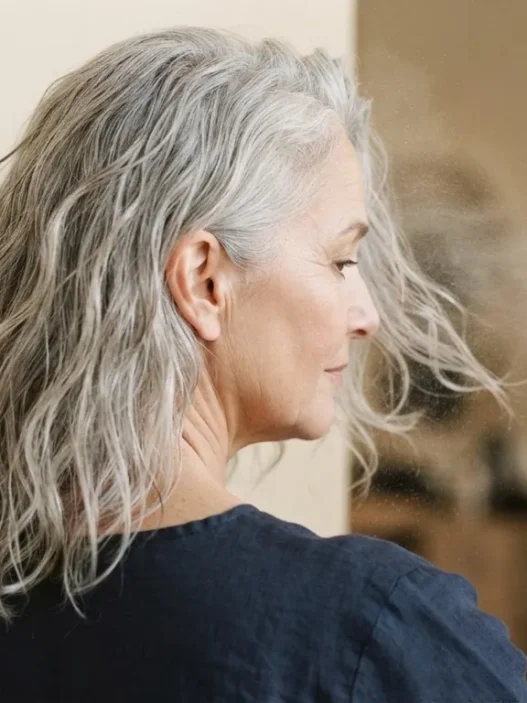
- The wavy lob: This is my number one. Sitting below the jaw and above or at the collarbone, with any kind of natural wave or soft layering built in. The wave breaks the horizontal perimeter. The length clears the jaw. Works on almost every hair type, including grey hair that has a natural coarser texture — and that natural texture can actually be an advantage here.
- The layered bob with a slight angle: Longer at the front, slightly shorter at the back. The diagonal hemline counters the jaw’s horizontal. Works especially well if you have a strong occipital bone (the back of the skull) because the angle draws the eye around rather than straight across.
- The textured short crop / pixie with volume: For the woman who wants something low-maintenance and modern. Key details: height at the crown, soft texture through the sides, nothing too architectural or severe at the perimeter. Ask for it to be finished with a natural wave or messed texture rather than a sleek finish.
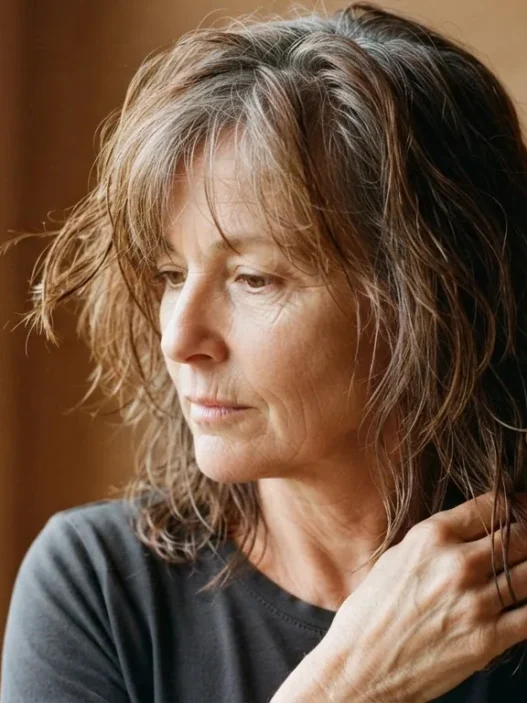
- The soft shag: Layers from the crown down, curtain fringe optional. The curtain fringe, specifically, does something wonderful — it breaks the forehead’s horizontal width with a central part and draws the eye inward and downward. The layering at the sides means the hair has movement rather than weight. I’ve talked about how layering works through different hair types in my post on wavy haircuts for women over 50.
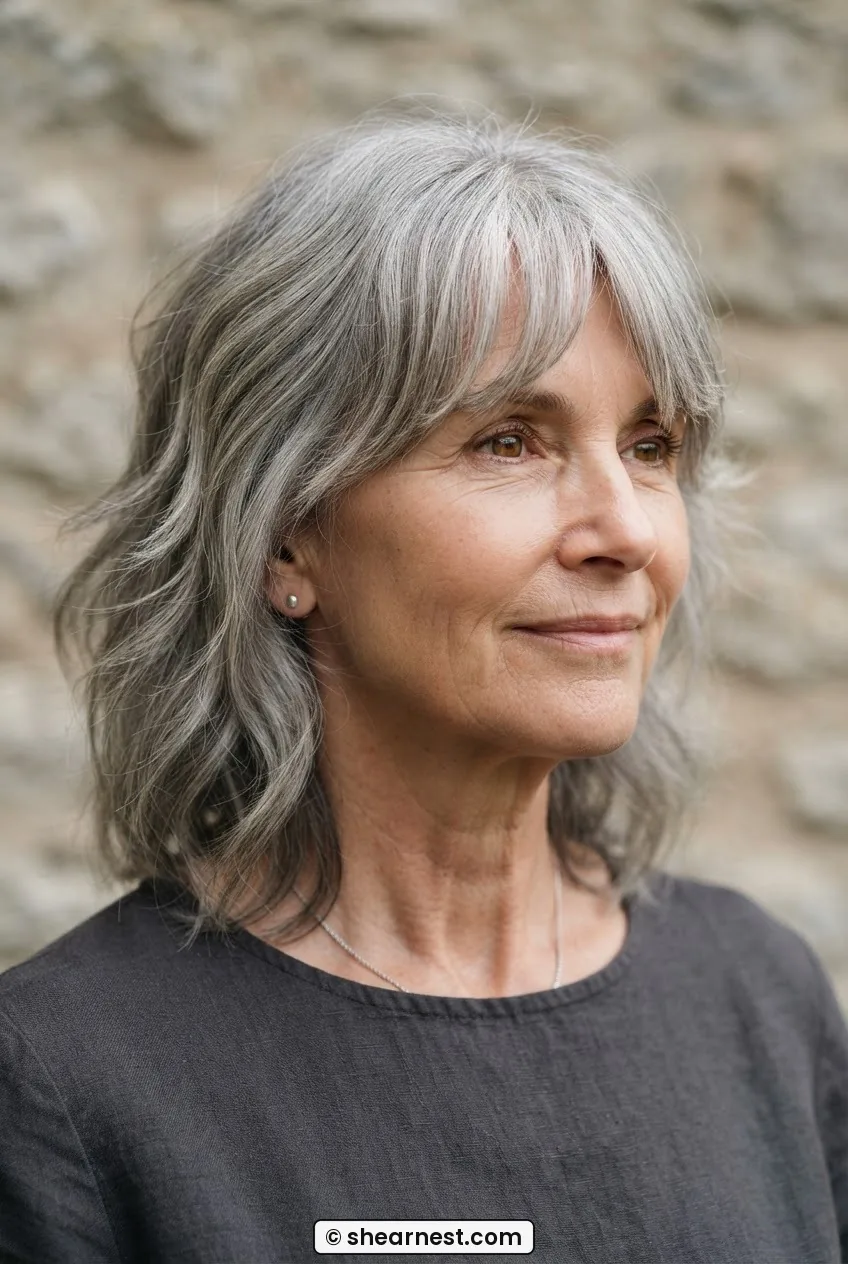
What connects all of these? Movement. Not volume for its own sake, not layers as a box-ticking exercise, but actual movement in the hair’s perimeter. When the ends aren’t sitting perfectly parallel to the jaw, the jaw stops being the dominant visual element. That’s the whole game, really. And you can also look into hairstyles for strong jawlines for a broader picture of how other women are approaching this.
One thing worth mentioning for those who are exploring cuts as they move into their seventies: the same principles apply, though the hair itself often has different needs — texture, density, elasticity all shift again. My piece on hair styles for women over 70 addresses how those changes affect cut choices specifically.
A Tutorial That Shows the Technique
Questions I Get About This
Should I avoid bangs if I have a square face?
Not necessarily — it depends entirely on the style of bang. Blunt, straight-across bangs can reinforce the horizontal lines of a square face and make the forehead feel heavier. But curtain bangs, wispy fringe, or soft side-swept bangs work beautifully. The curtain bang specifically introduces a central parting that breaks the width visually. It’s one of the most flattering fringe options I know for this face shape after sixty.
What if my hair is very fine — can I still get a lob?
Yes, though the approach changes slightly. Fine hair at lob length can fall flat, which removes that all-important movement. The fix is usually a combination of invisible layers to add lift through the mid-lengths, and a styling routine that encourages wave or bend rather than a smooth blowout. Mousse, a diffuser on low heat, and sleeping on a loose braid the night before are all options worth knowing. The wave doesn’t have to be dramatic — just enough to break the perimeter line.
My jaw has softened with age — do the same rules still apply?
Broadly yes, but the conversation shifts. If the jaw has softened significantly, you’re working with a softer rectangle rather than a hard square, and some of the more rigid rules about avoiding horizontal hemlines relax a little. I’d still avoid a perfectly blunt chin-length bob — that endpoint is rarely flattering on any face shape after sixty — but a jaw-length cut with movement and slight layering becomes more viable than it would have been at forty. Tell your stylist what you see when you look at your jaw now, not what you remember from fifteen years ago.
Does grey hair change how a cut looks on a square face?
It does, and mostly for the better. Grey hair — particularly natural grey that has some coarseness or wave to it — has a texture that helps create movement without much effort. That natural texture means a lob or layered bob often moves more freely than it did when hair was finer or straighter. The light also reflects differently off grey hair, which softens the overall silhouette. In my experience, women with grey or silver hair and square faces often find the transition to grey actually helps their haircut look better, not worse.
The woman who came in with the printed photo left with a wavy lob — slightly longer than the blunt bob she’d wanted, with soft layering and a slight angle at the front. She came back six weeks later to say her daughter had asked where she’d got it done. I’m not telling that story to pat myself on the back. I’m telling it because the right cut doesn’t usually come from the photo you bring in. It comes from the conversation that happens after you put the photo down. Whatever you’re considering, trust what you see in the mirror over sixty more than what worked at forty. Your face knows things your photograph doesn’t.