



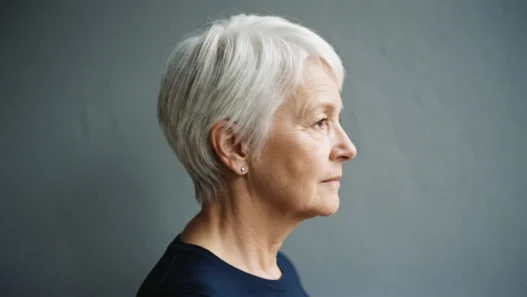

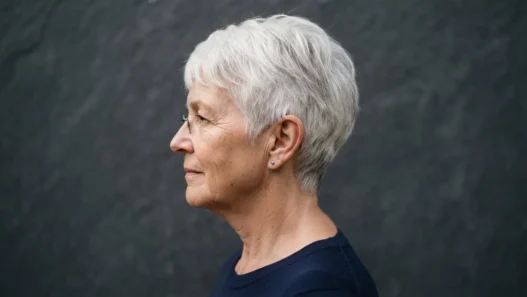

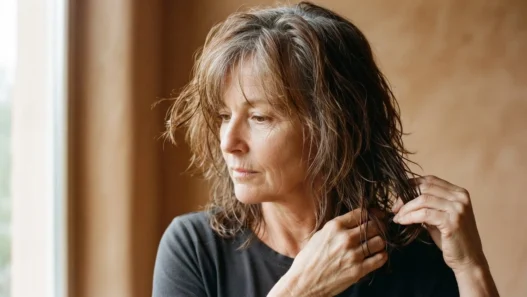

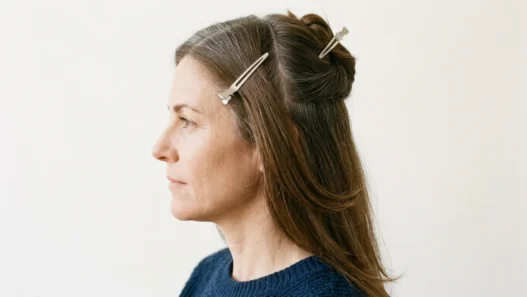
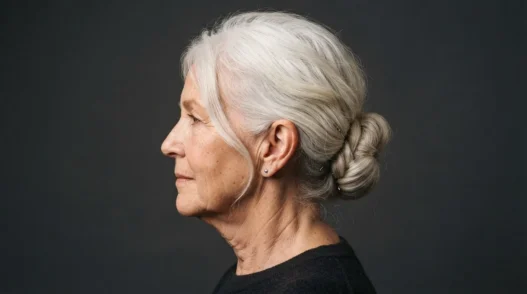
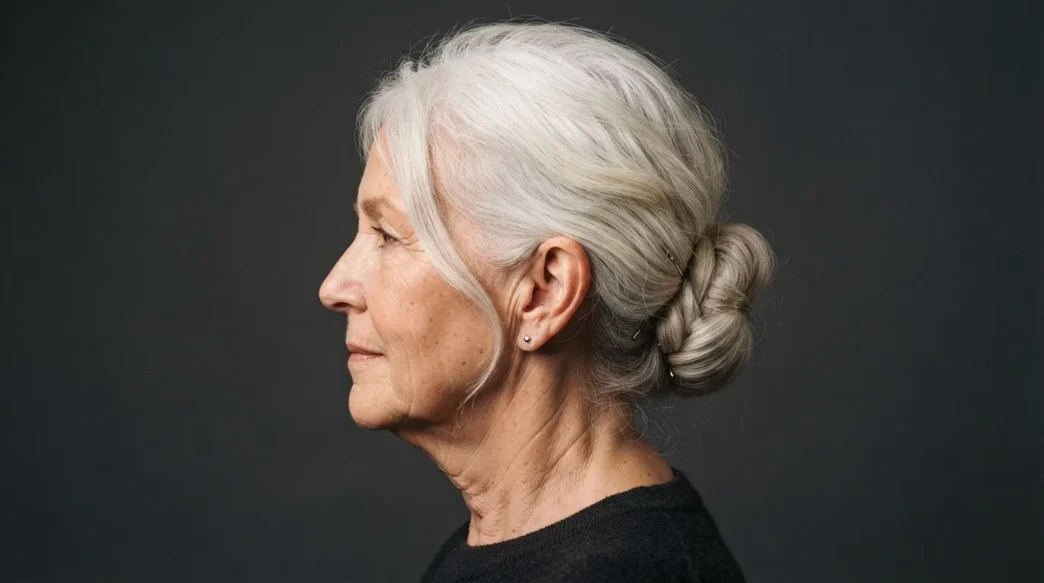
I’ve watched a lot of women walk into a salon the week before a wedding saying they want “something elegant and simple” — and then leave with something that looked better on a 25-year-old Pinterest board than on them. That’s not a slight. It’s a construction problem. Low bun wedding hair for mature women is genuinely its own category, and the difference is in where the weight sits, how much surface tension the bun carries, and whether the hair around the face is doing something kind or just getting in the way. I’ve been obsessing over this topic for months and these nine are the ones I keep coming back to.
9 Low Bun Styles Worth Requesting at the Chair
- The Classic Chignon With a Knot Centre
- The Rope-Twist Bun Built on a Braid
- The Wrapped Ponytail Low Bun
- The Asymmetric Side Bun
- The French-Twist-Into-Bun Hybrid
- The Knotted Loop Bun for Fine Hair
- The Half-Up Low Bun for Medium-Length Hair
- The Loose Gathered Bun With Face-Framing Pieces
- The Pinned Chignon With No Visible Elastics
1. The Classic Chignon With a Knot Centre
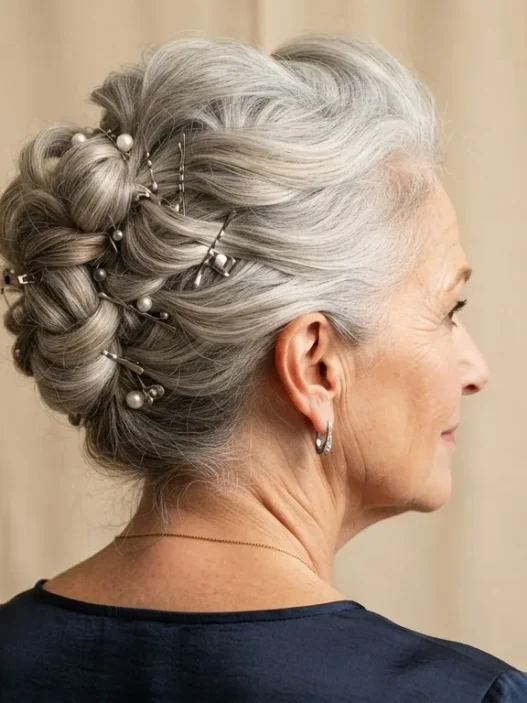
This is the one I’d call the baseline. The hair is gathered low — typically at or just below the occipital bone — then formed into a single, flat knot that sits against the nape. The outer layer wraps around the knot to conceal any bulk, and pins go in horizontally through the roll to anchor it. No loops. No loops stacked on loops. Just the clean geometry of a coiled finish.
It suits women with medium to thick hair best — there needs to be enough weight for the outer wrap to lie smooth. Fine hair can achieve it with a small doughnut form underneath, which honestly nobody needs to know about. Look at the way her nape is fully exposed in the photo — that unbroken line from ear to collarbone is exactly why this style photographs so beautifully at weddings.
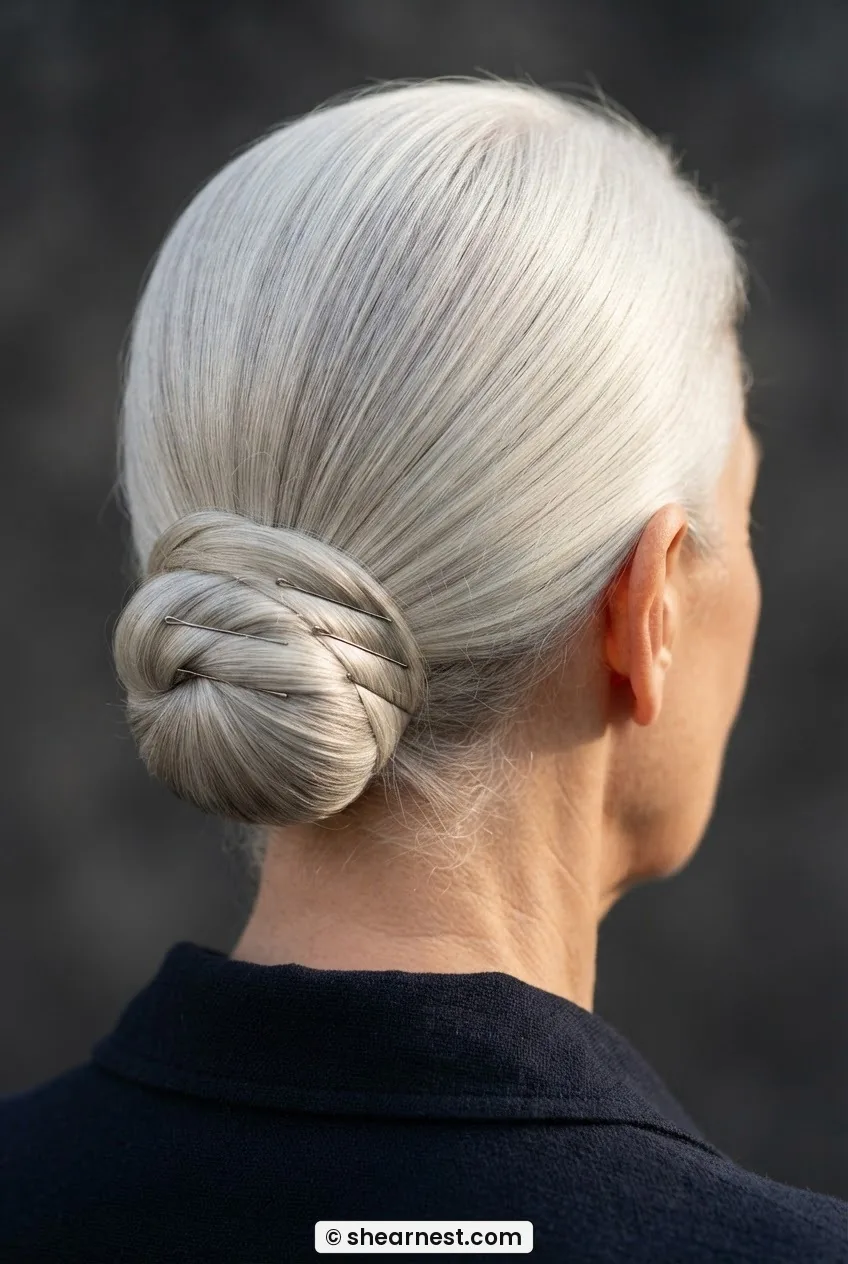
Upkeep between appointments: if you’re coming in for this at sixty-plus, a fresh trim four to six weeks before the wedding keeps the perimeter clean. Scraggly ends ruin the wrap. What to say at the chair: “I want a flat chignon, knot centred at the nape, outer layer wrapped and pinned through horizontally.”
2. The Rope-Twist Bun Built on a Braid
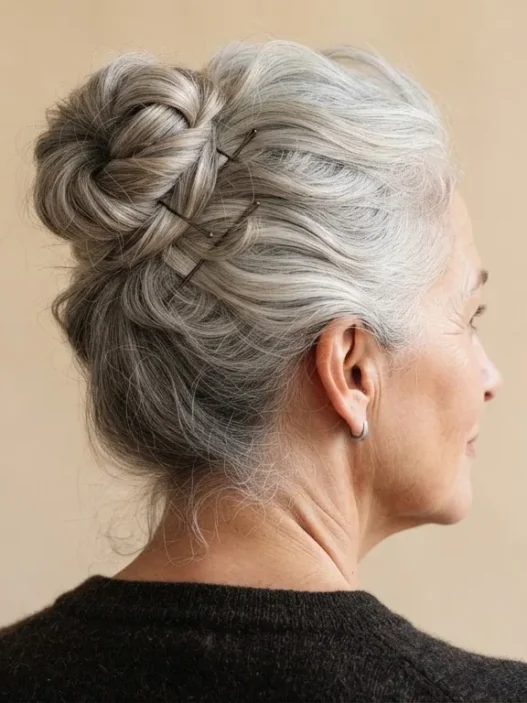
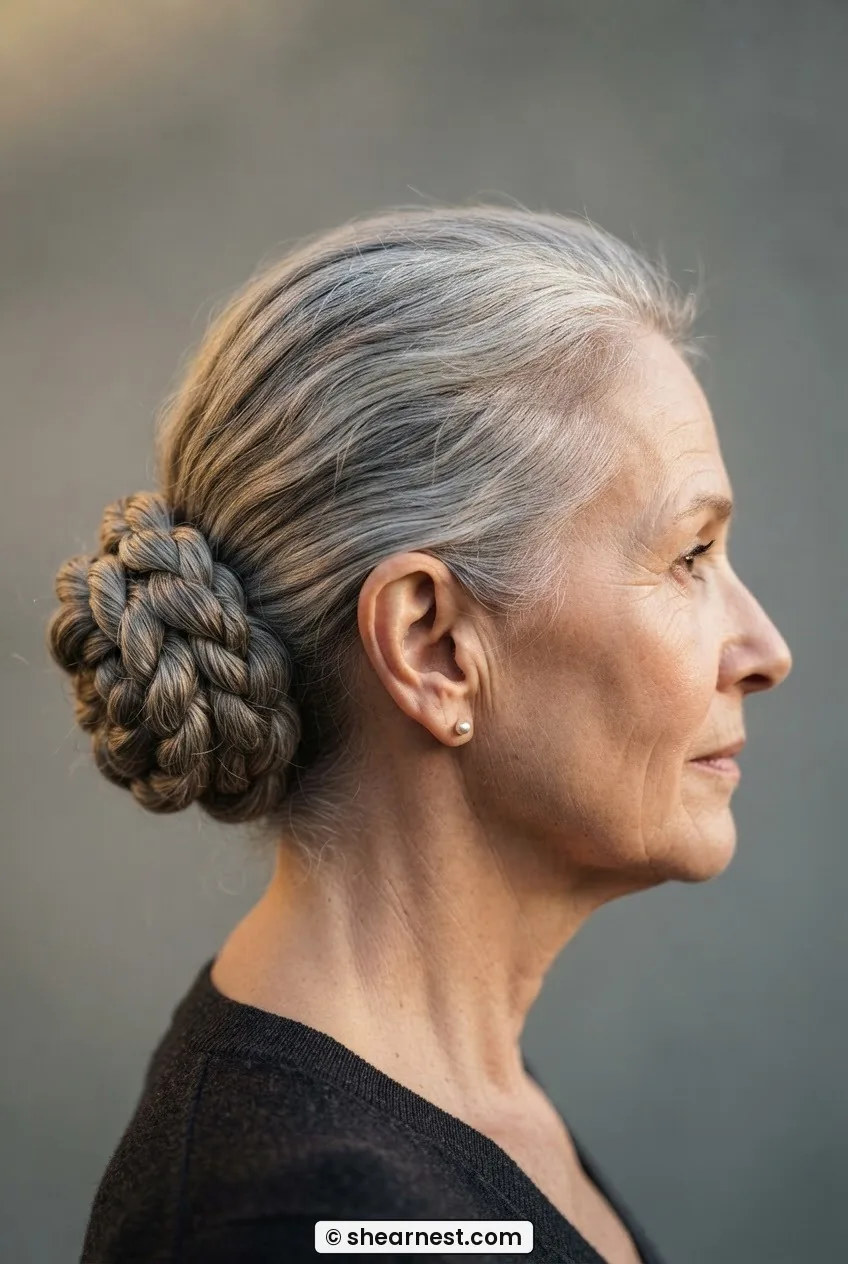
Underneath the finished look there’s a three-strand braid running from the nape downward — that braid then gets coiled into the bun and pinned, so the texture you see on the surface is the braid’s external ridges catching the light. It reads as intricate without being fussy. The weight distribution is different from a standard chignon: the braid keeps the bun from going pancake-flat, which is a genuine issue for women with finer hair post-50.
Who it suits: anyone whose hair has lost some density at the crown. The structure of the underlying braid creates the illusion of more volume than is actually there. Upkeep-wise, this one rewards a protein treatment in the weeks before — braids look sharper when the cuticle is smooth. What to say: “Start with a three-strand braid at the nape, then coil and pin the braid into itself. I want to see the braid ridges on the outside of the bun.”
3. The Wrapped Ponytail Low Bun
Simpler in construction than it sounds. A low ponytail is secured with an elastic, then the tail is split, flipped up through the gap between the elastic and the scalp (Topsy-tail style), and the resulting loop gets pinned flat. It creates a small, tidy bun with a seam running horizontally — and that seam, oddly, looks intentional and elegant when done well.
I love this one for medium-length hair that isn’t quite long enough to do a full chignon. If you’ve been reading about straight hair cuts for women over 50 and wondering whether your current length limits your updo options — it really doesn’t, and this style is evidence. The bun sits close to the head rather than protruding, which ages beautifully. Upkeep: essentially none between now and the wedding. What to say: “Low topsy-tail, then pin the loop flat against the nape so it reads as a clean horizontal bun.”
4. The Asymmetric Side Bun
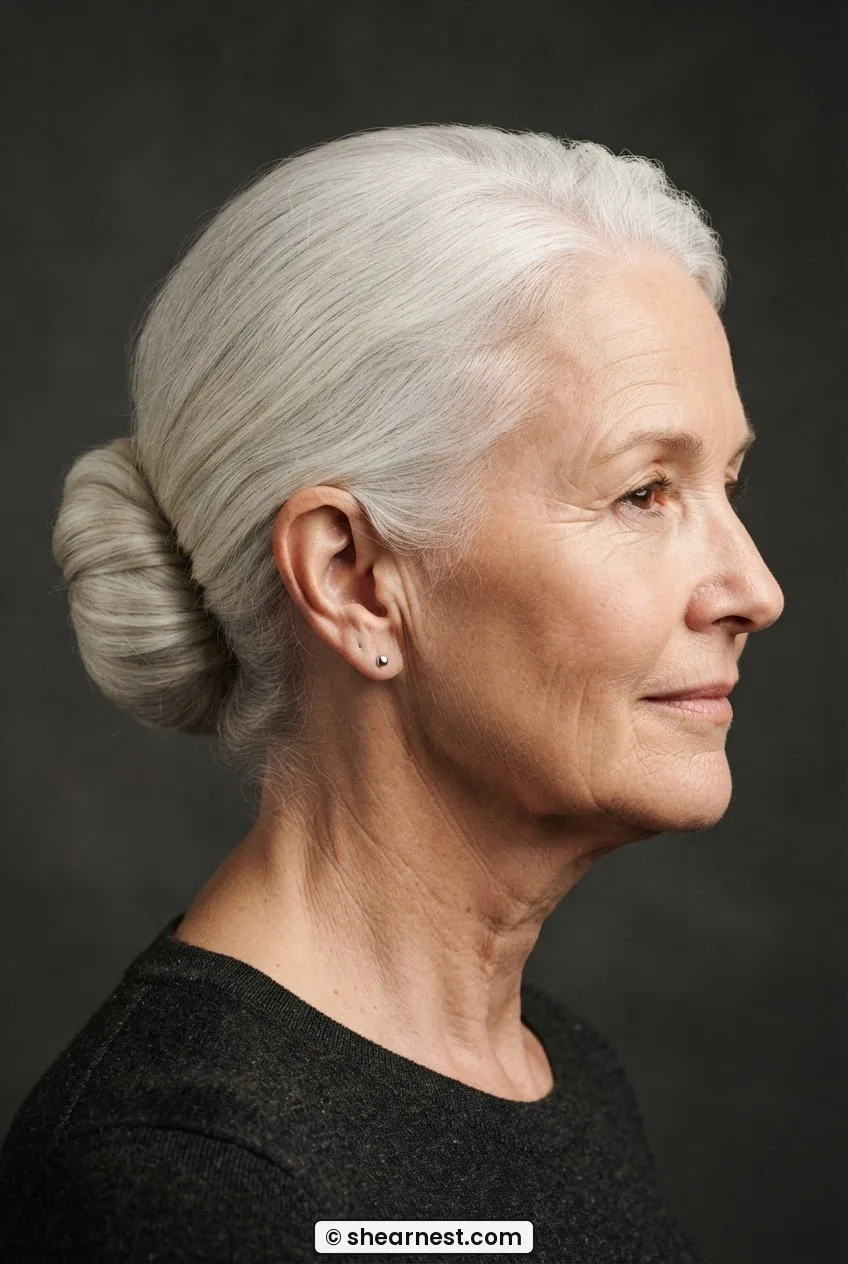
The gathering point shifts about two inches toward one ear, and the bun — still low, still below the occipital — sits off-centre. That small displacement changes everything about how the face reads. On a softer jawline it creates a subtle diagonal line that draws the eye sideways rather than straight down. On women with rounder faces it’s particularly good.
The construction is otherwise identical to the classic chignon: gather, knot, wrap, pin. But the asymmetry means one side of the face has a clean temple and the other might have a soft piece pulled forward. She’s letting one small piece fall in front of her ear in the photo, and that’s exactly the level of softness I’d recommend — just enough to stop the style looking severe, not so much that it reads as “falling down.” Upkeep: a clean hairline matters here, so if your temples are a touch unruly, a tiny bit of taming product the morning of makes a real difference. Say at the chair: “Low chignon, shifted two inches to my left side. One loose piece on the right temple only.”
5. The French-Twist-Into-Bun Hybrid
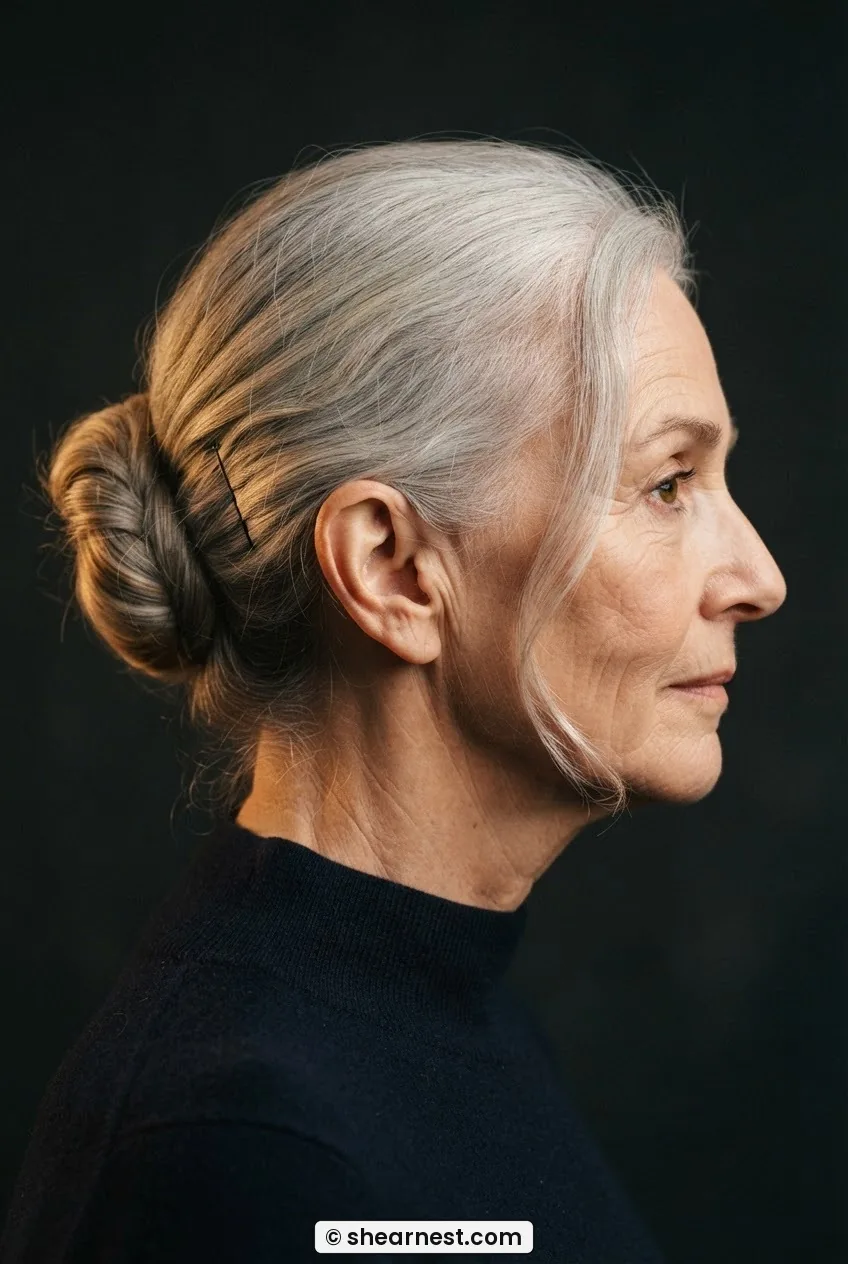
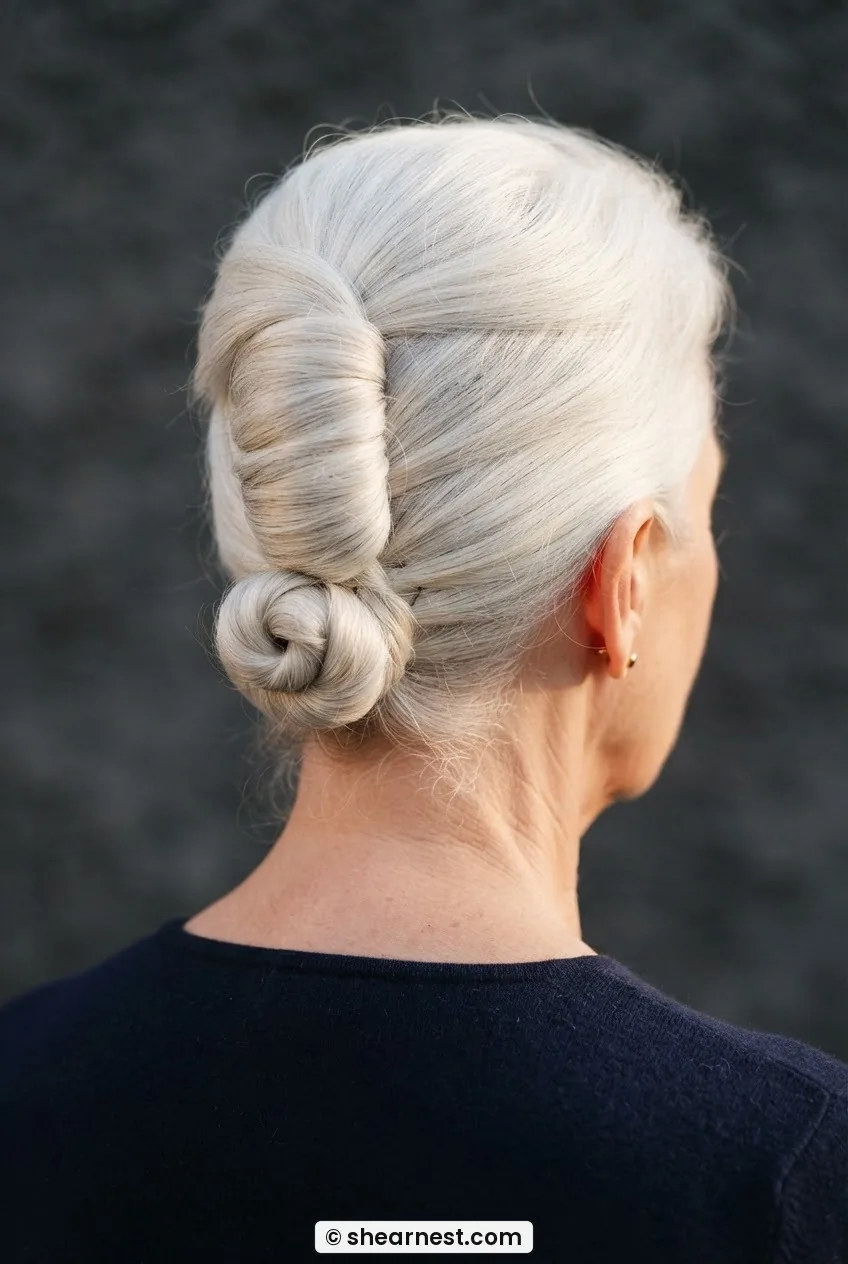
This is my personal favourite of the nine. The back section is gathered into a vertical French twist — that rolling technique where the hair folds in on itself from one side — but instead of tucking all the ends into the twist, the remaining ends are folded into a small flat bun that anchors right at the base of the twist. So you get the vertical lift and elegance of a French twist with the finished, tucked-away neatness of a bun.
“Of everything I’ve seen in the past year, this hybrid is the one that photographs beautifully from every angle — not just the back. The twist gives vertical interest, the bun anchors it, and neither one overpowers the face. For women over 50 who want something that reads as genuinely formal, this is it.”
For a detailed walkthrough of how the French twist mechanism works before you go in for your trial, the 60+ French twist updo method breaks it down clearly. Who it suits: women with medium to long hair, particularly those with enough thickness to create a solid twist without gaps. Upkeep: the twist needs smoothness, so a gloss treatment four weeks before is worth it. Say at the chair: “French twist at the back, but instead of tucking all the ends, fold them into a small flat bun at the base of the twist. I want both elements visible.”
Watching Someone Build This From Scratch
6. The Knotted Loop Bun for Fine Hair
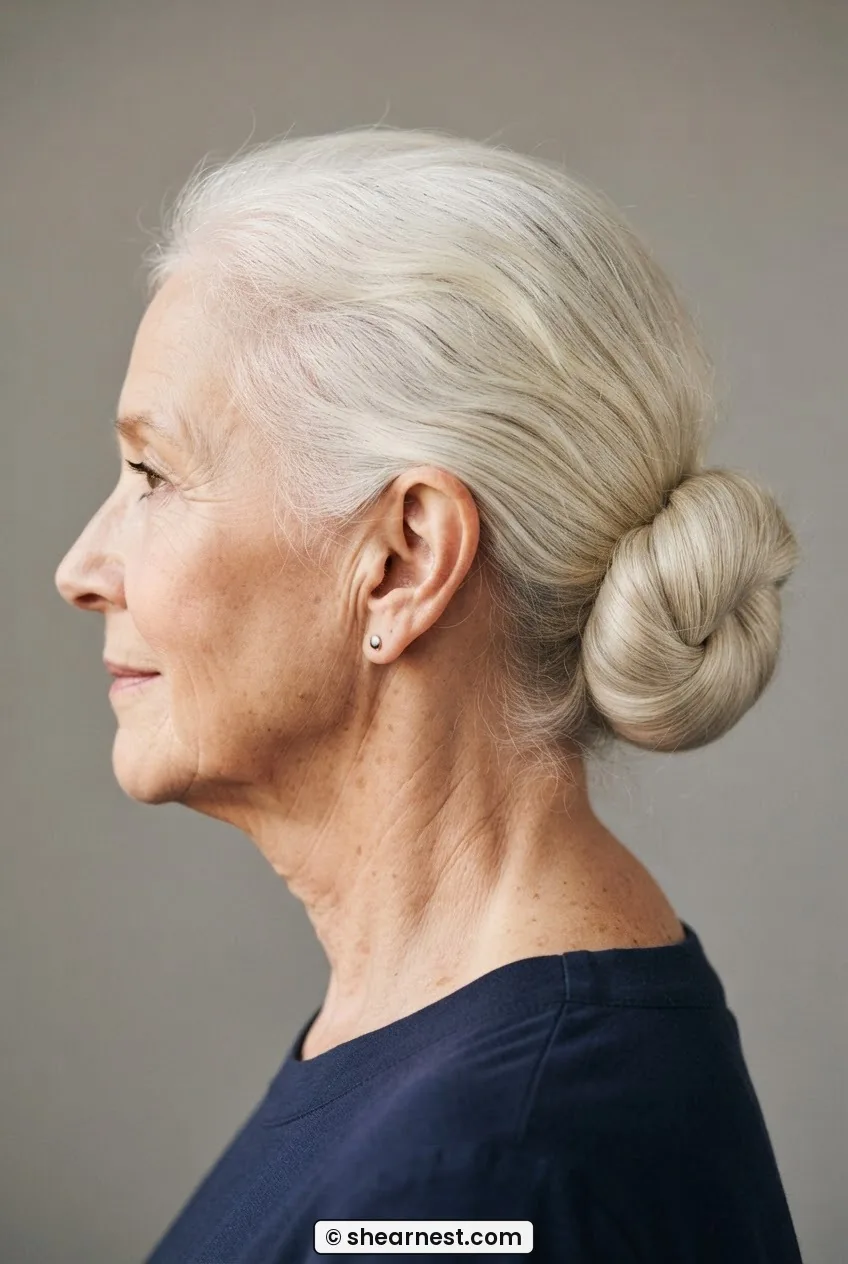
Fine hair over fifty is its own specific puzzle. The knotted loop bun solves it by working with the hair’s lightness rather than fighting it. The technique: gather at the nape into a low ponytail, fold the tail back on itself without fully pulling it through (so it creates a loop rather than a straight tail), then wrap the loop in both directions around its own base and pin through all layers. The result looks like a full, rounded bun — but it’s partially hollow, which means no elastics straining thin hair and no flat, defeated-looking knot.
If you’ve been looking into styles specifically for fine hair updos that hold, this construction consistently comes up as one of the most reliable. Who it suits: explicitly for fine or thinning hair — if you have thick hair, the loop gets too bulky and loses its shape. Upkeep: volumising mousse applied to damp hair a day before helps the finished bun hold its roundness. Say at the chair: “Knotted loop bun at the nape — I want the loop wrapped around itself, not pulled through, so there’s no elastic tension on the ponytail base.”
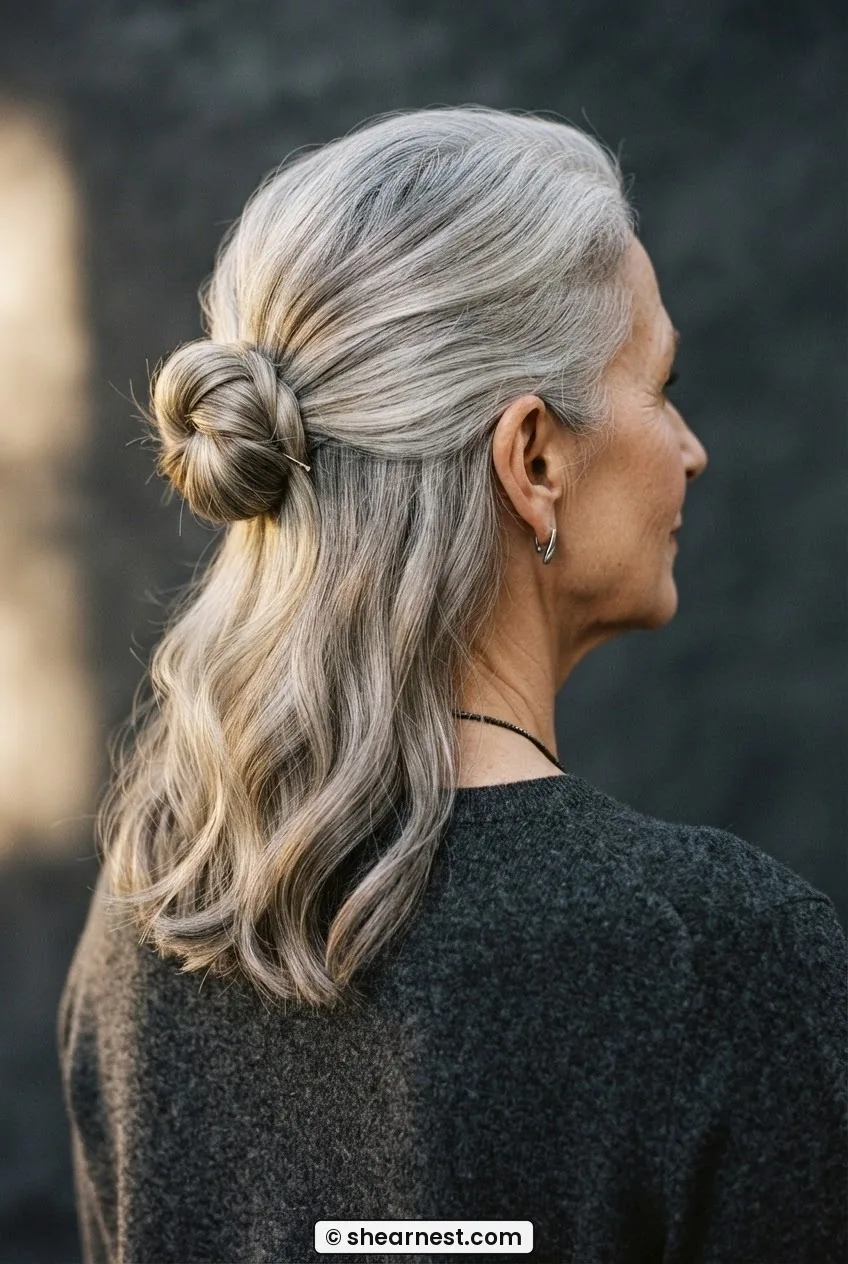
7. The Half-Up Low Bun for Medium-Length Hair
Not everyone wants everything up. The half-up low bun takes the top and crown sections — roughly from the temples to the crown — gathers them into a low ponytail just above the nape, and forms that portion into a small bun. The rest of the hair falls loose below. It’s ideal for a wedding guest look or even a mother-of-the-bride style where being completely pinned-up feels too formal but fully down feels too undone.
The construction distinction that matters: the bun sits at the nape, not at the crown. Crown half-up buns skew young and casual. Nape placement keeps the whole thing grounded and elegant. For women with wavy hair, the down sections look particularly beautiful left as-is — you can read more about how wave patterns behave in updos over at this piece on wavy haircuts for women over 50, which also covers how to work with rather than against texture. Who it suits: medium-length hair (lob to shoulder blade), wavy or straight. Upkeep: this style forgives a little growth, so no emergency trim needed. Say at the chair: “Half-up bun, everything from temple to crown gathered and formed into a small bun at the nape. Bottom half stays down.”
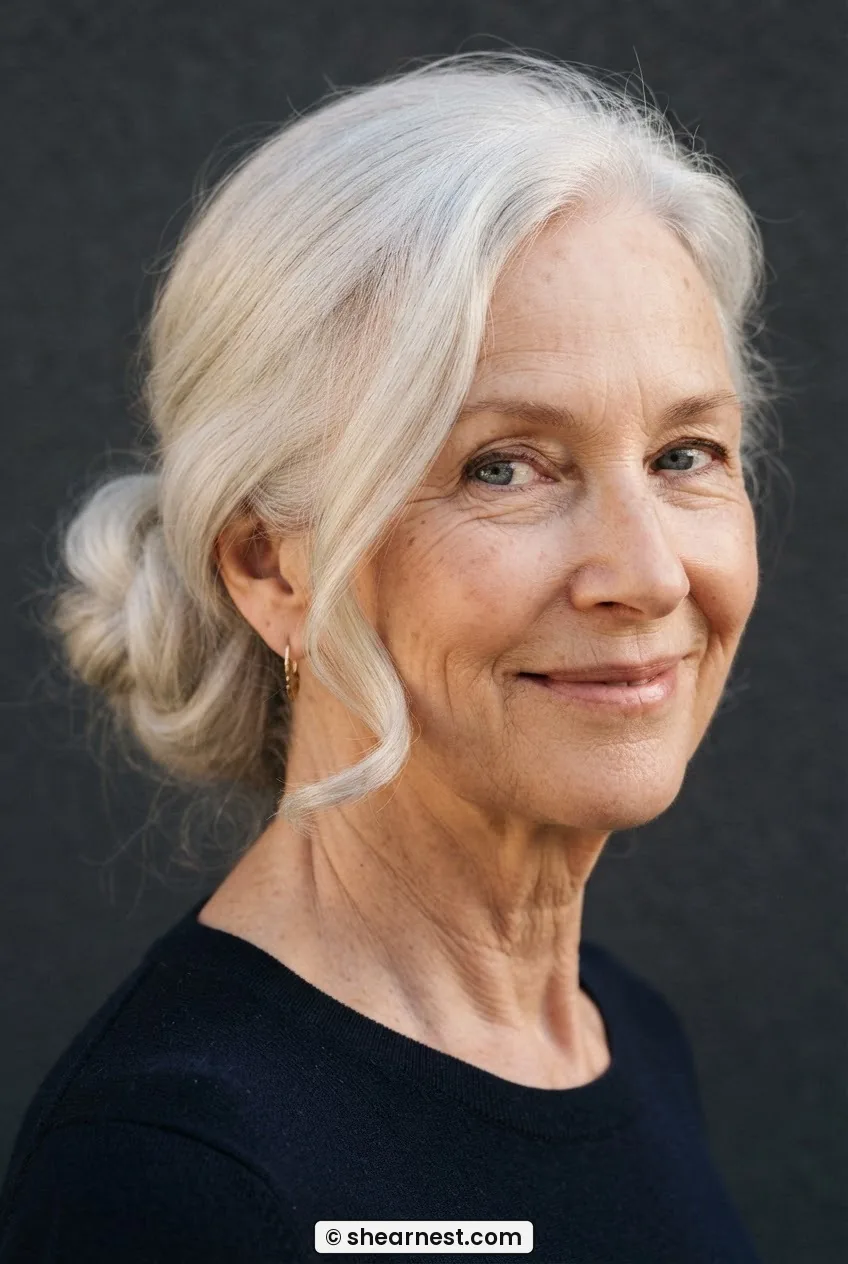
8. The Loose Gathered Bun With Face-Framing Pieces
This is the one for women who panic at the idea of anything too structured. The bun itself is gathered loosely — the outer wrap doesn’t need to be perfect, and a few tendrils are intentionally left out around the hairline before pinning. The face-framing pieces are the key variable: they should be soft, not crimped, and they should follow the natural hairline rather than being forcibly pulled forward.
Where this differs from “a messy bun”: the gathering point is deliberate (low at the nape), the pins go in with intention (no fly-aways from the crown), and the loose pieces are pre-selected — not accidental. It reads as effortless because the effort happened at the right moments. See how she’s got one curved piece following the ear in the photo — that’s the framing I mean. It’s not random; it was chosen and shaped before the bun was pinned. Upkeep between appointments: if your hairline hairs are fine and short, a little curl cream on those pieces gives them the shape to stay put. Say at the chair: “Low gathered bun, not pulled tight. Pre-select two face-framing pieces at the temples, shape them, then pin everything else. I don’t want this to look messy — just soft.”
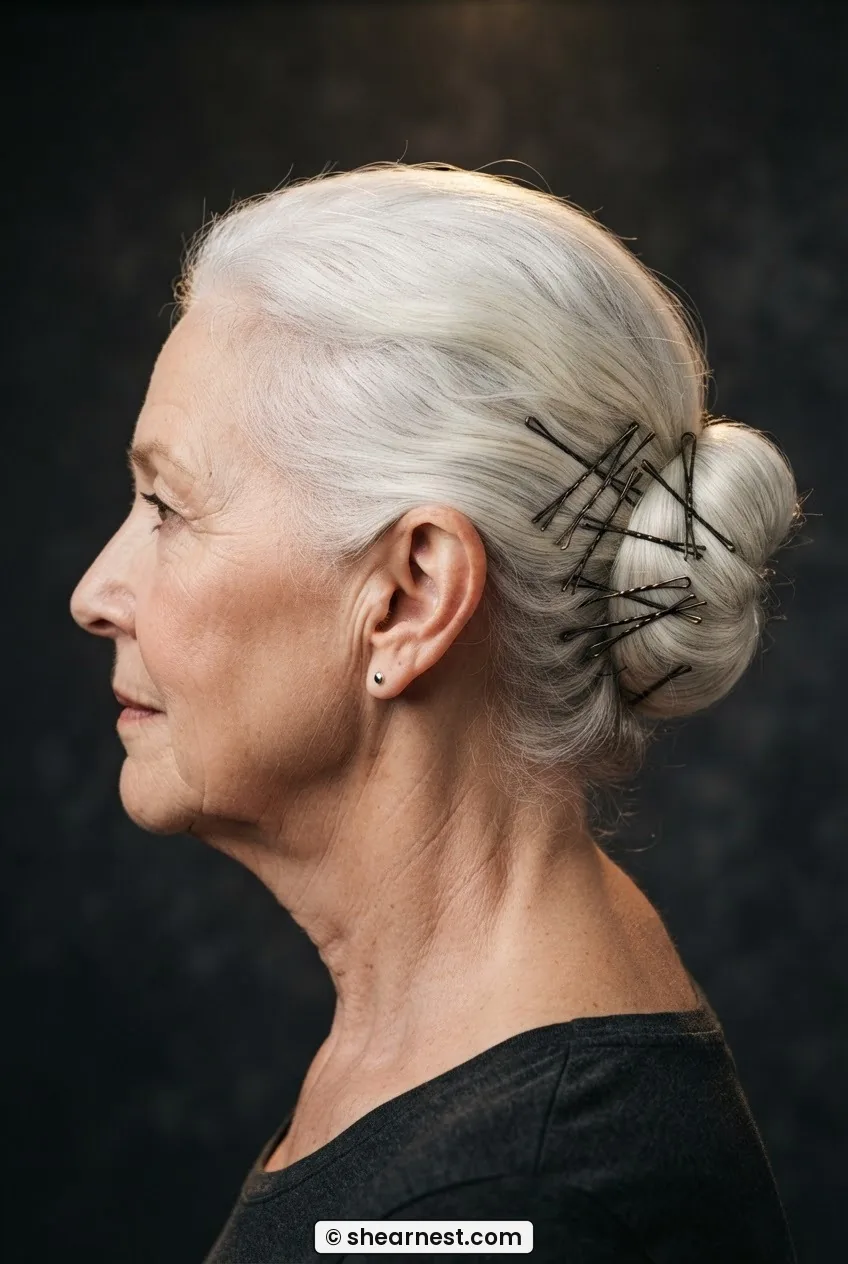
9. The Pinned Chignon With No Visible Elastics
Everything is pinned directly to the scalp — no elastic at the base, no visible anchor point. The hair is gathered by hand, held at the nape, and individual sections are crossed over each other and pinned alternately so they hold without a band underneath. A good stylist can achieve this in under ten minutes; a less experienced one may want thirty. Ask at your trial which approach your stylist uses.
Why does no elastic matter? Elastics create a dent at the base of the ponytail that can show through the wrap, especially on finer or straighter hair. They also pull in a single direction, which can create scalp tension during a long event. This version distributes that tension across multiple pin points instead. For women over 70 who want to understand how hair structure changes and why this kind of construction sometimes works better as hair density decreases, the piece on hair styles for women over 70 covers that territory honestly. Upkeep: this style needs clean, product-free hair to grip the pins properly — don’t wash with a heavy conditioner the morning of. Say at the chair: “Elastic-free pinned chignon. I want the weight distributed across multiple horizontal pins, not held by a band at the base.”
Questions I Get About This
How far in advance should I book a wedding hair trial?
At least six to eight weeks before the event is my standard advice. That gives you time to go back for a second trial if the first attempt wasn’t right, and it also means you can get any colour or treatment work done in between without panic. Don’t skip the trial — the photos last forever.
Can a low bun hold all day on fine hair without looking flat by evening?
Yes, with the right construction — specifically the knotted loop method (number six above) or the pinned chignon with no elastic (number nine). Both avoid the single-point tension that causes fine hair to collapse. A light-hold spray applied in sections during the build, not as a final coating, also makes a significant difference to longevity.
Should I put accessories in a low bun for a wedding?
It depends entirely on the construction. The classic chignon and the pinned chignon carry a pearl pin or a simple comb beautifully — something placed at the side of the bun rather than on top. The loose gathered bun works with small florals tucked into the outer wrap. I’d steer away from tiaras or anything that requires the bun to sit perfectly level, because low buns have a natural slight tilt that can make tiaras sit crooked. You can look at how pins and combs work in updos for a guide on placement that actually holds.
Does face shape affect which low bun is most flattering?
It’s less decisive than people think at this level, because all nine styles sit below the crown and don’t dramatically change the silhouette around the face. The asymmetric side bun (number four) tends to be most flattering on rounder faces. For oval faces, almost anything from this list works — the guide on oval face hairstyles for women over 50 explains why that face shape has the most flexibility with updo placement.
Honestly, any of these nine would look beautiful at a wedding — the question is which one matches your hair’s actual weight and texture, not which one looks best on someone else’s Pinterest board. Take the construction language I’ve given you, book the trial, and tell your stylist exactly what you want. Stylists love specificity. And if they look at you blankly when you say “elastic-free pinned chignon” — that’s useful information too. You deserve someone who knows what that means. Good luck, and enjoy every moment of the day itself.