



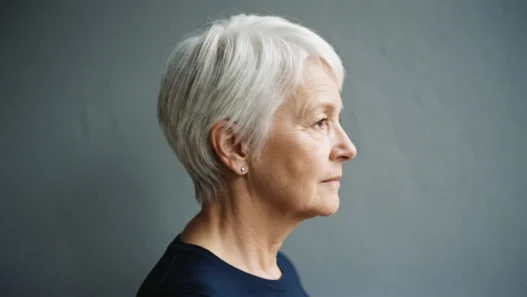

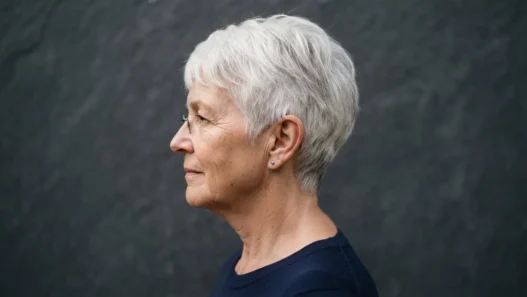

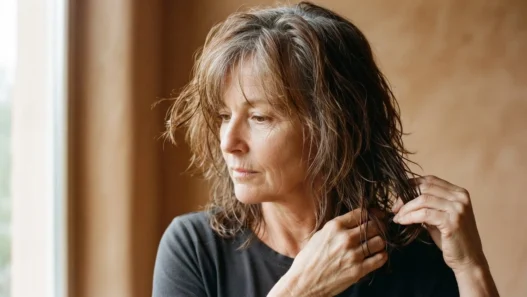

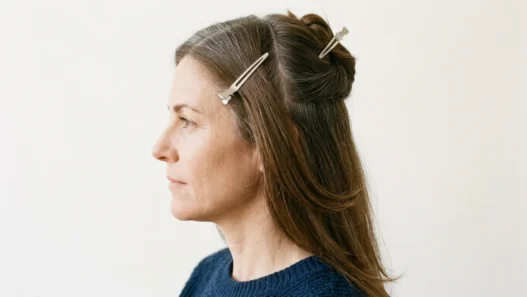
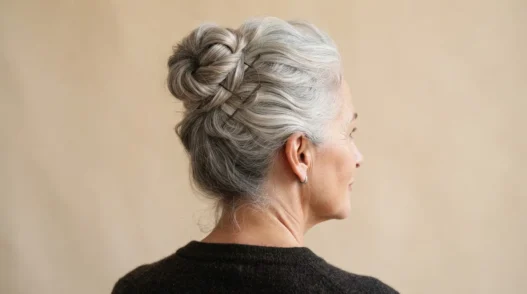
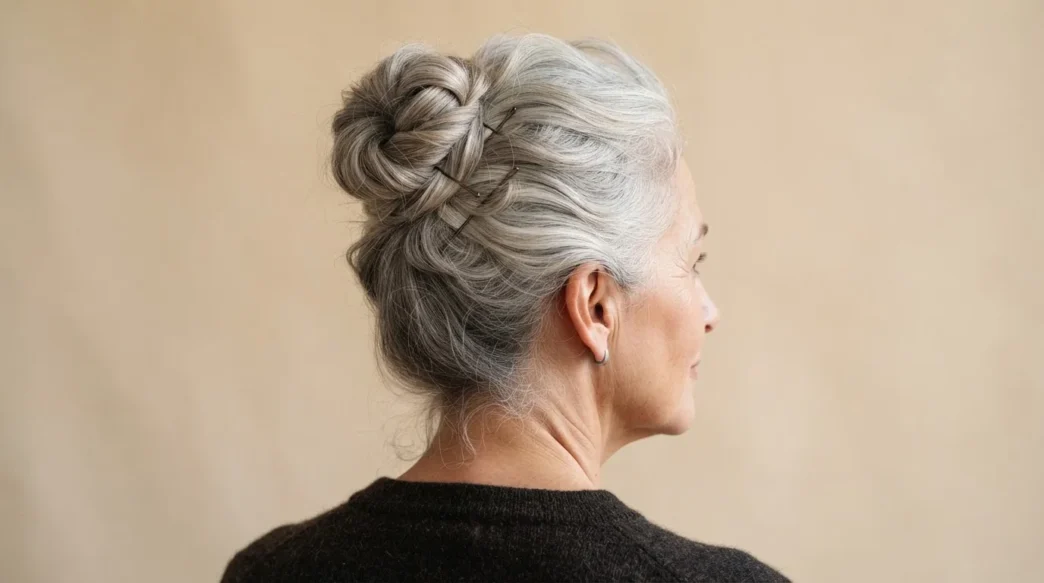
I’ve been pinning updos for years and ignoring about 90% of them because they assume you have the hair of a 25-year-old — thick, grippy, and completely cooperative. Over 50, the texture changes. The density changes. And the way a bun sits on your head changes too. What looks effortlessly tousled on someone else can look flat and sad on finer strands. So this list is specifically about construction — where the weight sits, how the pins grip, and what actually holds through a long evening. These are the nine high bun hairstyles I’d genuinely recommend, and I’ve tried to be honest about who each one is actually for.
1. The Loose Textured Knot
This is the one that photographs beautifully but requires a bit of setup. The hair is gathered at mid-crown — not at the very top of the skull, which can feel severe, and not at the nape, which isn’t really a high bun at all. The ponytail is loosely twisted rather than tightly wound, so the resulting knot has visible gaps and movement. Individual sections are gently pulled to widen the silhouette before pinning. Weight sits in the middle of the bun, not at the edges, which is what keeps it from drooping on finer strands.
This suits women with medium-density hair who want something that reads as relaxed but still occasion-appropriate. Upkeep between appointments is minimal — it actually looks better on hair that hasn’t just been blown out, because the slight roughness gives grip. At the chair, ask for a cut that preserves length through the crown so you have enough length to gather without too much tension.
2. The Low-Tension Pinned Crown
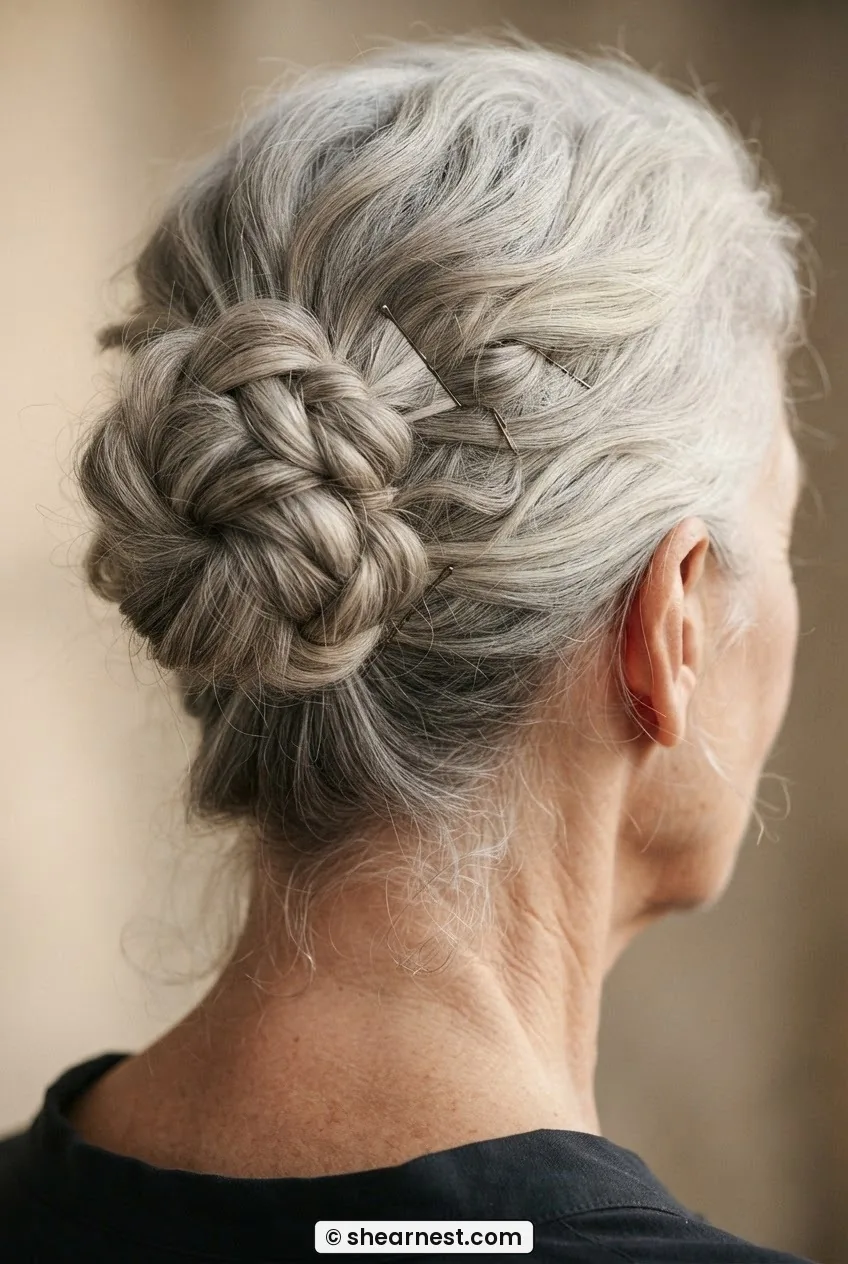
Tension is the enemy of a comfortable updo after 50. The scalp is more sensitive, the hairline is often more fragile, and a tight elastic pulled high will make the whole style look strained rather than polished. This version solves that by building the shape with pins rather than elastic pressure. Hair is sectioned into three panels — two side sections and one back — and each is rolled and pinned independently before the sections are tucked into each other at the crown. The result looks cohesive but was never pulled tight in one go.
Who is this for? Anyone with a sensitive scalp, a fragile hairline, or anyone who finds traditional high buns give them a headache by hour three. Upkeep is zero between appointments — you’re working with the hair’s natural fall, not fighting it. At the chair, ask your stylist about protecting a fragile hairline so the front sections aren’t compromised over time.
3. The Braided Wrap Bun
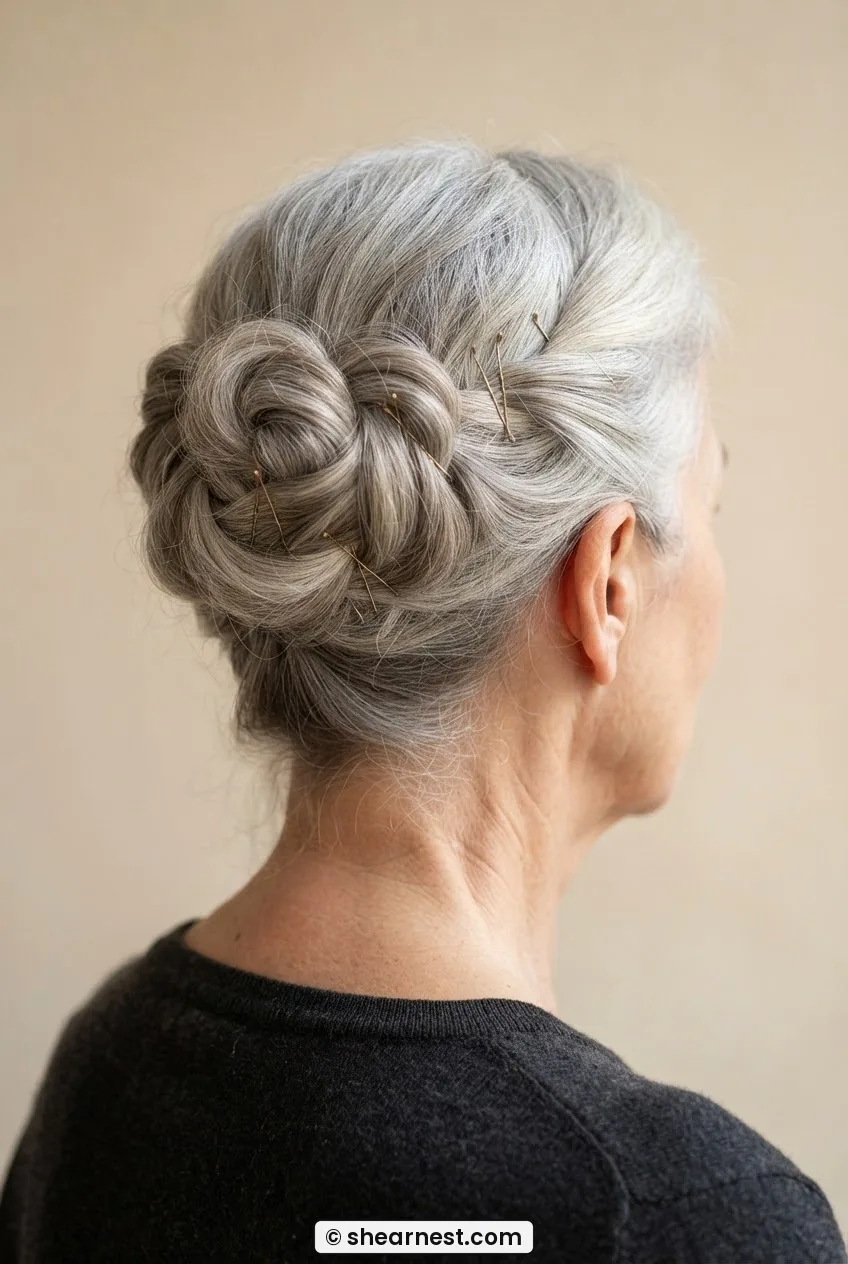
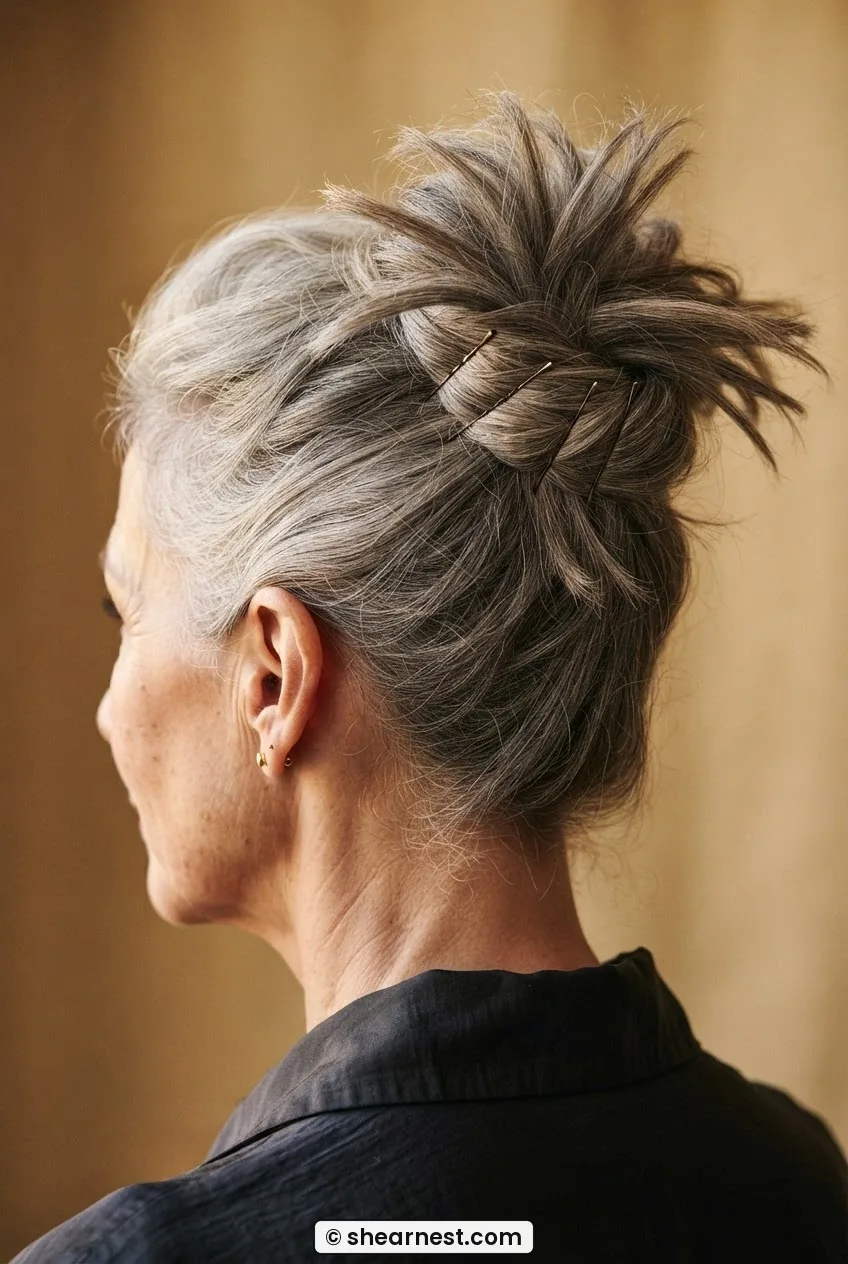
A small braid — usually a loose three-strand, sometimes a rope twist — is worked from one side and wrapped around the base of the bun to act as both decoration and anchor. The bun itself can be quite modest in size because the braid does visual work, adding perceived volume and interest without requiring more hair. The weight of the braid actually helps the bun stay put, which is a practical bonus. Construction-wise, the bun goes up first, then the braid is worked from a small section just above the ear and pinned over the base.
This is my personal pick for a wedding or occasion updo — it looks considered without being stiff, and it photographs brilliantly from every angle.
I first saw a version of this on a woman at a friend’s garden wedding — silver hair, loose braid just catching the light, the rest pinned up simply. She looked incredible. No fuss, no lacquer helmet, just genuinely elegant. I went home and practiced it for a week. It’s not as hard as it looks, and it holds better than almost anything else I’ve tried on hair that’s lost some density.
Best for medium to thick hair — the braid needs something to work with. For finer strands, see the Padded Volume Bun further down. Between appointments, a light texturizing spray gives the braid more grip and definition.
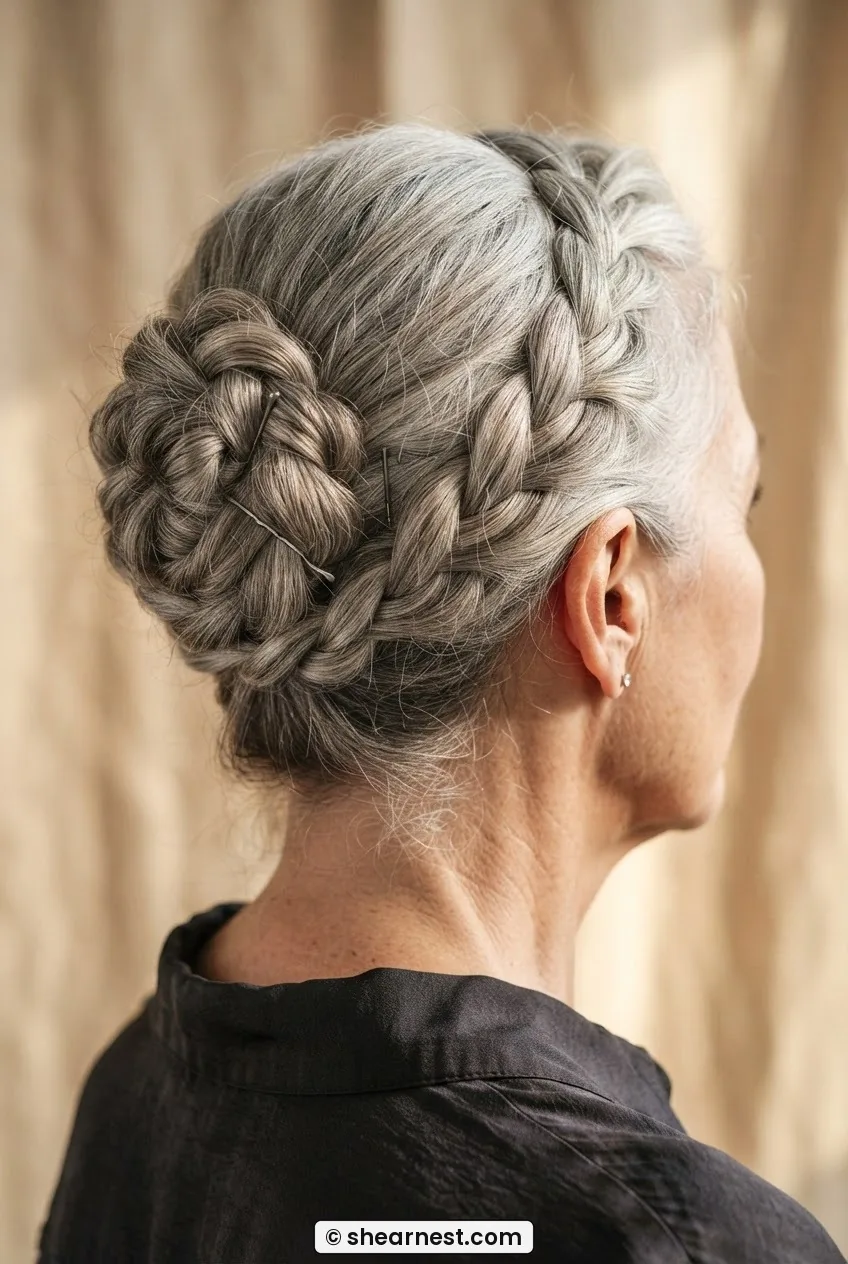
4. The Half-Up High Knot
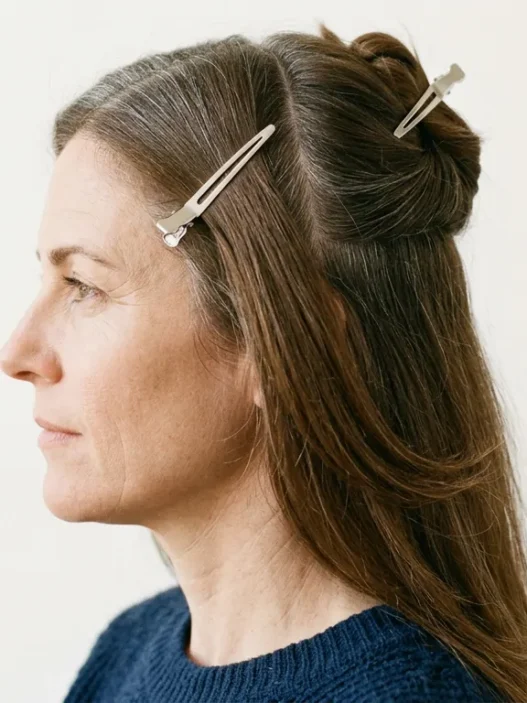
Not every high bun has to be a full updo. The half-up version takes just the top two-thirds of the hair — crown section and sides — and gathers them into a small knot at the apex of the skull, leaving the lower layers loose. The weight of the knot sits entirely in the gathered section, which means gravity isn’t pulling on a full head of hair. That matters when hair is finer and lighter.
This is a brilliant everyday option and the one I default to for daytime events where a full updo feels overdressed. It also works well for anyone who’s been reading up on haircuts for fine hair over 50 and has recently gone shorter at the back — the half-up keeps the front and top longer while showing off the shorter underlayers. At the chair, tell your stylist you want to wear your hair half-up, so they cut with that in mind and don’t remove so much length that you lose the option.
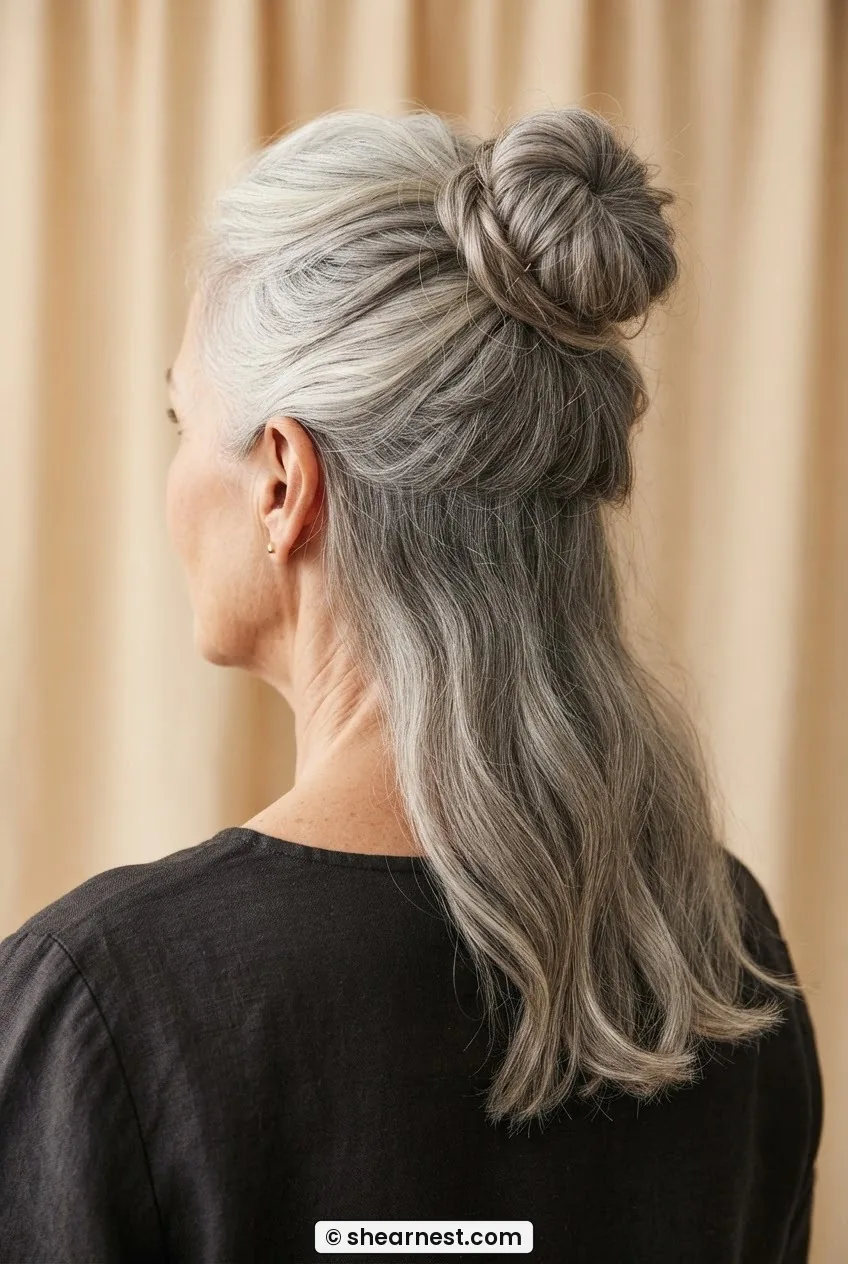
5. The Sleek Architectural Bun
This is the formal version — polished, intentional, zero flyaways. Hair is smoothed back with a boar bristle brush, gathered precisely at the crown, and wound tightly into a disc-shaped bun that sits flat against the skull. The edges are finished with a fine-tooth comb and a light pomade, and the whole thing is sealed with pins and a flexible hold spray. Think of it as sculpture rather than styling.
Here’s the thing about sleek buns over 50: they require the right face shape and bone structure to land well. On an oval or long face they can be stunning. On a rounder face they can feel too concentrated at the top. Have a look at what works for different structures — the breakdown of oval face hairstyles for women over 50 is a good starting point for understanding proportion. This style also needs a bit of density — very fine hair won’t build the flat disc shape without padding or backcombing underneath. Upkeep is high: you need smooth, well-conditioned hair or the sleekness turns into frizz.
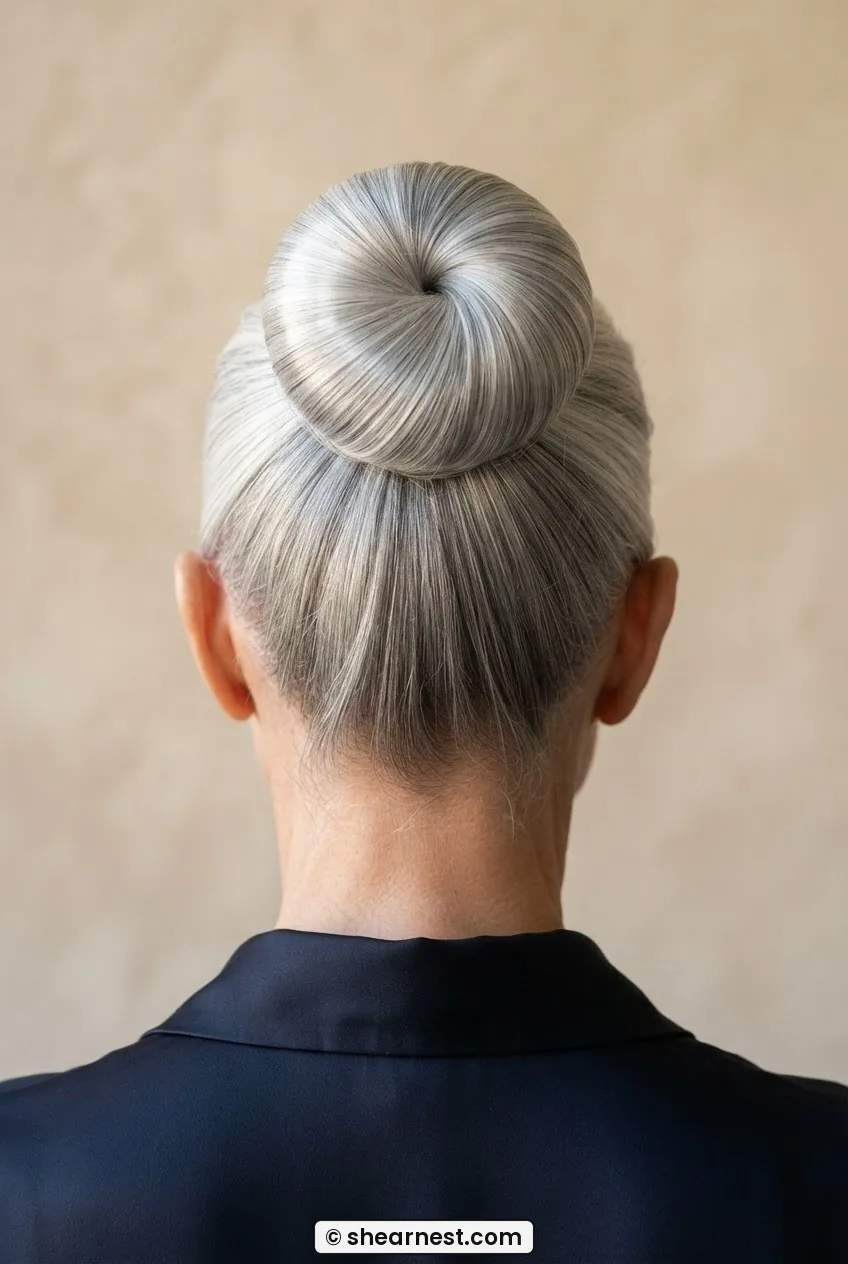
6. The Twisted Crown Updo
Two large rope twists — one from each side — travel across the crown and meet at the back, where the ends are tucked under and pinned. The “high” element here is the arc of the twist across the top of the head, which creates height without requiring hair to be gathered at the very top of the skull. It’s a softer read than a classic bun, and the rope texture catches light in a way that photographs beautifully on silver and white hair.
Upkeep between appointments: minimal. The twist itself hides a lot of texture variation, so hair that hasn’t been freshly styled actually grips better. This works on medium to shorter long hair — you need roughly collar-bone length or above so the ends tuck cleanly. At the chair, mention you want to wear this style regularly and ask for the layers to be kept long enough through the sides to make the twist without too much tension.
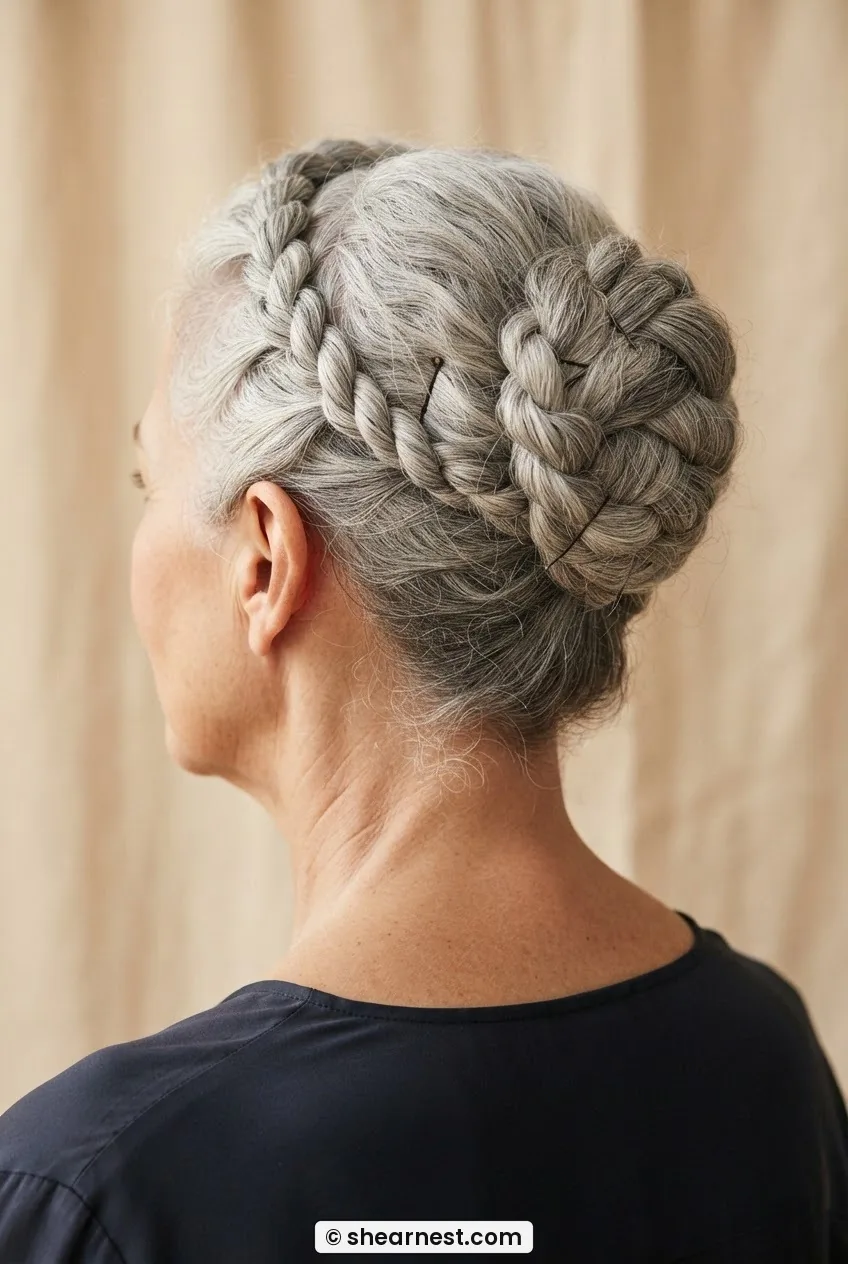
7. The Padded Volume Bun
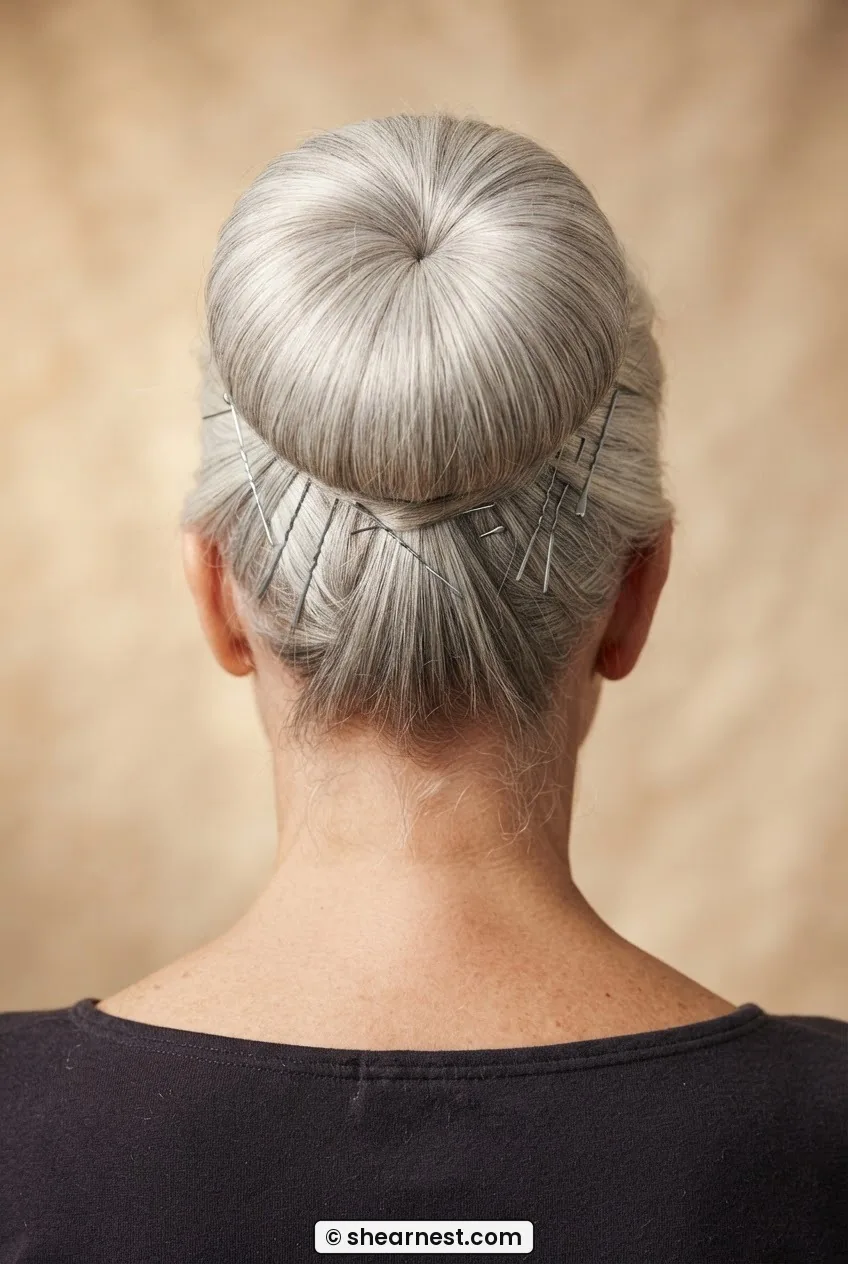
This is the honest answer to fine hair that desperately wants an updo. A small foam or mesh doughnut — or even a rolled sock if you’re old-school about it — sits inside the bun and gives it structure from the inside out. The hair is wrapped over the pad and pinned, and the result looks genuinely full without needing a single extra gram of actual hair. The weight is supported by the pad, not by strand tension.
I cannot overstate how much this changes things for finer hair. If you’ve been putting off updos because your buns always look tiny and sad, this is the fix. The technique how to use a bun donut is well-documented and takes about five minutes to learn. Best worn with hair that has some grip from a light texturizer or dry shampoo — freshly washed silk-fine hair will still slip. You’ll find this especially useful if you’re navigating a haircut for fine hair over 50 and want updo options that don’t telegraph how much density you’ve lost.
A Tutorial That Actually Helped Me With Fine Hair
8. The Undone Chignon Lifted High
A chignon lifted to the high-crown position bridges the gap between formal and relaxed. The construction differs from a bun: instead of winding hair into a tight coil, a chignon folds the ponytail back on itself and fans the ends outward into a loose, flat shape before pinning. The silhouette is wider and flatter than a traditional bun, sitting more like a cushion than a ball. This distributes weight across more pins and generally stays more stable throughout the day.
This shape works particularly well for women with some natural wave or curl — the ends fan out beautifully when they have texture. Straight, fine hair benefits from a light wave set with a large-barrel iron before styling. For anyone exploring hair styles for women over 70 who want something more elevated than a low chignon but less structured than a formal bun, this lifted version is worth trying. It reads as deliberately elegant rather than accidentally informal.
9. The Pinned Fringe-Forward Bun
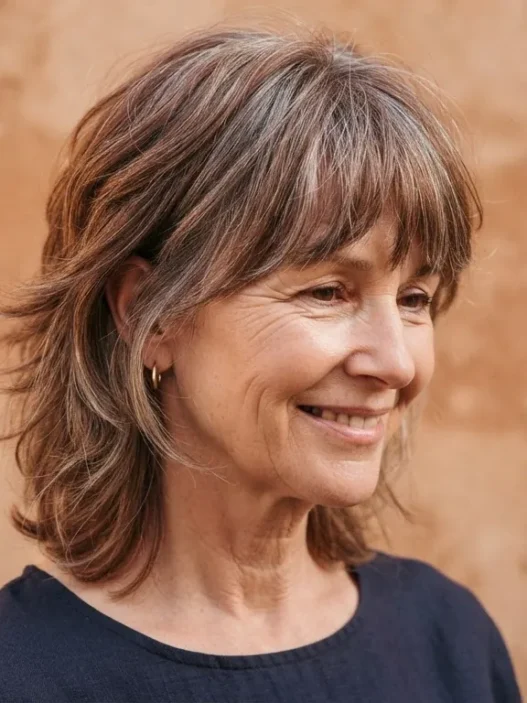
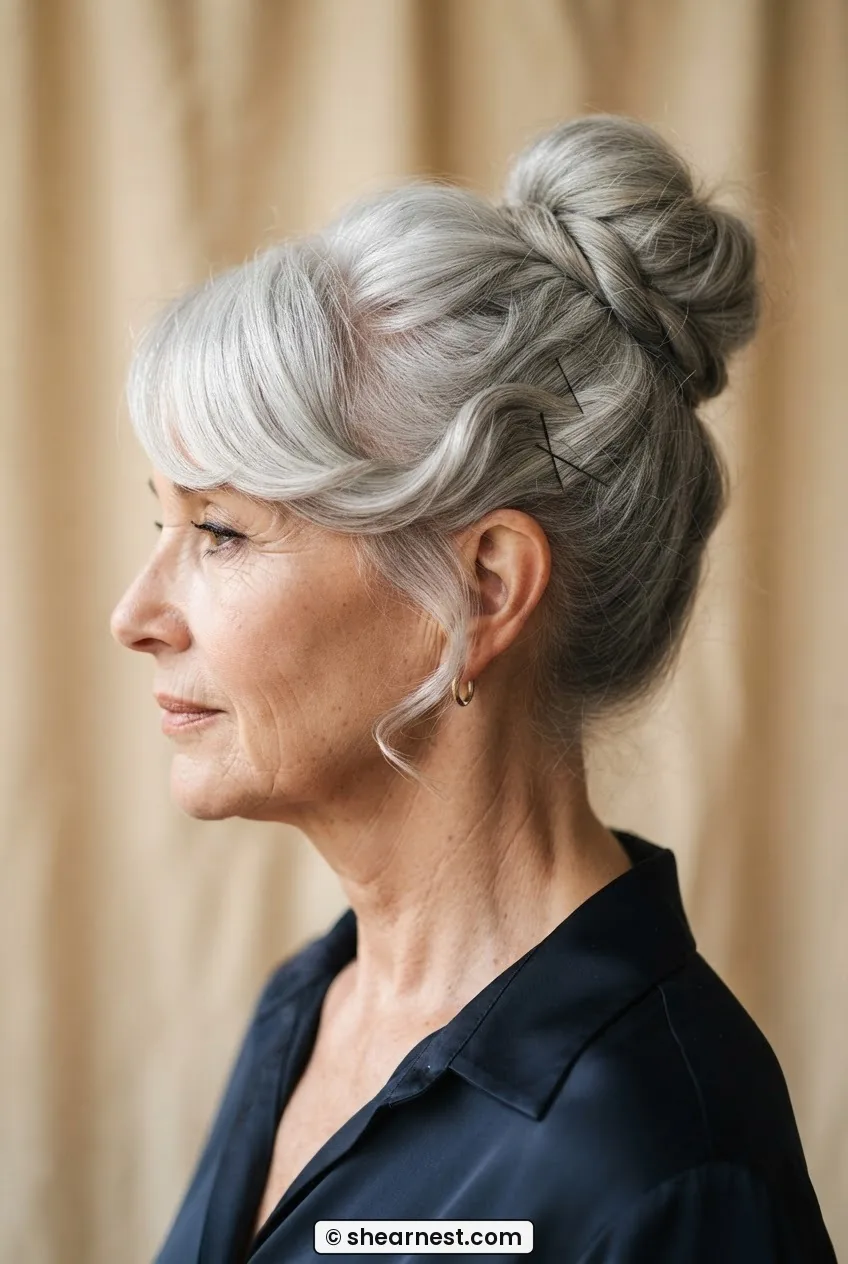
The bun goes up, but the fringe — or the front section of hair, if you haven’t got a cut fringe — is swept forward and pinned or secured in a wave across the forehead rather than slicked back. This changes the whole personality of the updo. It softens the face, frames the features, and takes the severity out of an otherwise pulled-back style. Construction: the back and crown go up first into whatever bun shape you choose, then the front section is rolled or swept and pinned at the temple.
Look at the woman in the image — see how those front pieces create a natural frame rather than exposing the hairline completely? That’s exactly why this works so well for anyone cautious about a pulled-back look revealing a receding or thinning hairline. It works across hair types, though it needs at least some length through the front. At the chair, ask to keep the front section longer than the rest so you have material to work with. If you’re curious about how fringe options integrate with updos, the broader conversation around hairstyles over 70 covers some of the same territory around softening the hairline with front sections.
Questions I Get About High Buns
Do high buns work on very short hair over 50?
Honestly, not really — not a traditional high bun. You need at least five to six inches of length through the crown to have enough hair to gather and pin. If you’re working with a shorter cut, the half-up knot or the twisted crown updo are more realistic because they only need the top section to be long enough. Worth a conversation with your stylist before you commit to a cut if you know you want updo options.
How do I make a high bun stay without using a ton of hairspray?
Grip comes from texture, not spray. Dry shampoo or a texturizing powder worked through the hair before you start gives strands something to hold onto. Then use enough pins — most people underpeg their buns and wonder why they fall. A light flexible-hold spray at the end for flyaways is fine, but if the bun is well-pinned, you won’t need the lacquer helmet. The braided wrap and padded volume versions hold especially well with minimal product.
Is a high bun suitable for fine, thinning hair?
Yes, with the right construction. The padded volume bun (number seven on this list) is specifically built for fine and thinning hair — the internal structure does the volumizing, not your actual strands. The half-up high knot and the twisted crown updo also work well because they don’t require gathering all your hair into one place. The sleek bun is the one to approach with caution — it needs density to look intentional rather than sparse.
What should I ask my stylist for if I want to wear high buns?
Tell them upfront. A stylist cutting for a high bun will protect length through the crown and keep layers long enough to gather without the shortest pieces escaping at the nape. If you want a fringe-forward style, they’ll need to keep the front section longer than the rest. The single biggest mistake is getting a cut that looks great down but leaves nothing to work with when the hair goes up — mentioning it at the start of the appointment changes the whole consultation.
That’s the nine. No filler, no “just scrape it up and hope for the best.” Each of these has a specific reason it works differently from the others — the construction is the point. If you’re still figuring out what cut to grow into for updo versatility, the guide on straight hair cuts for women over 50 is worth reading alongside this one. And if fine hair is your main concern, bookmark the one on updos for fine hair — it goes deeper on product and prep. Pick the bun that matches your actual hair, not the one that looks most dramatic on someone else’s Instagram. That’s always the better call.