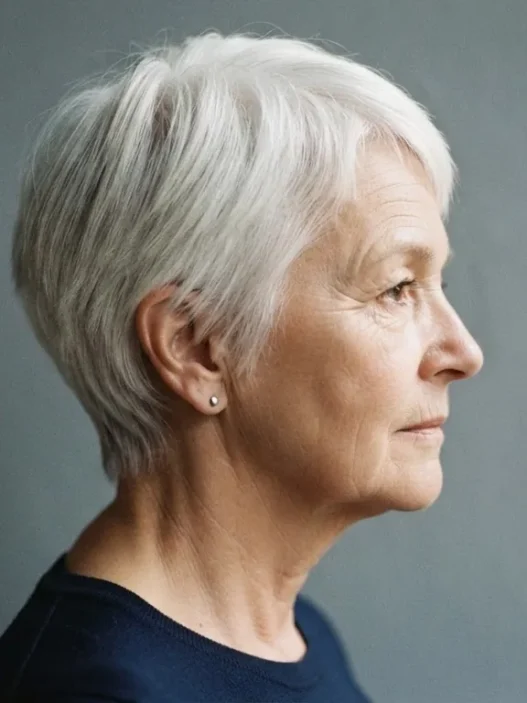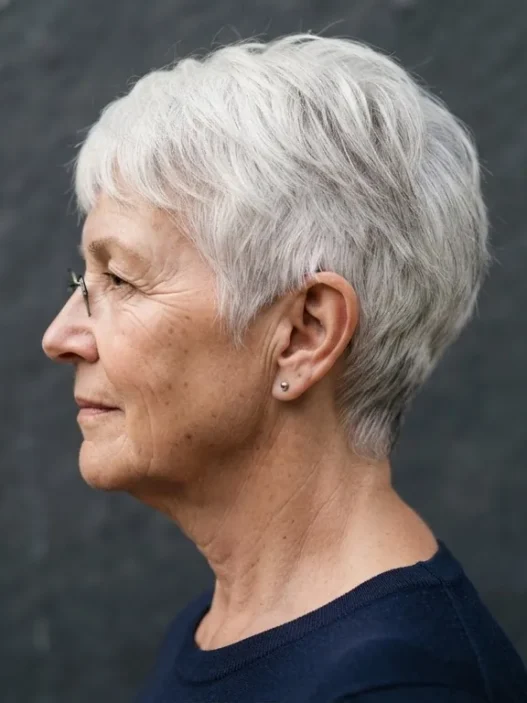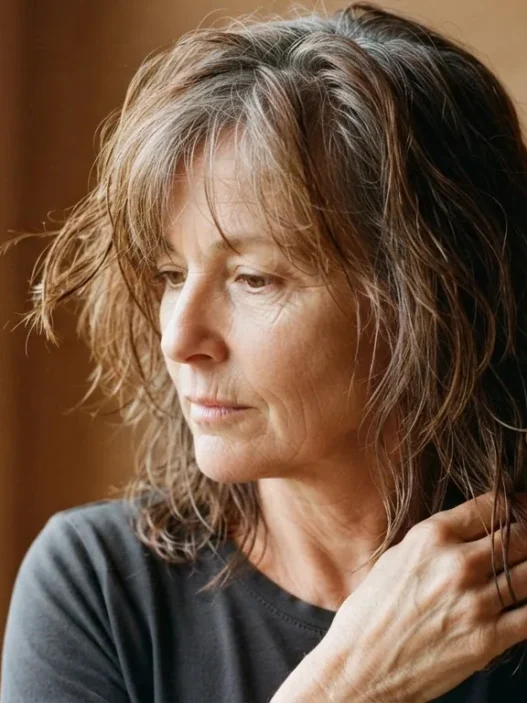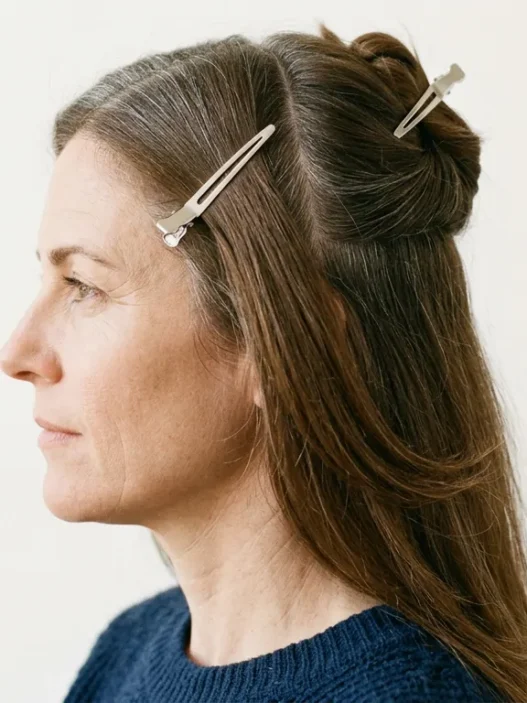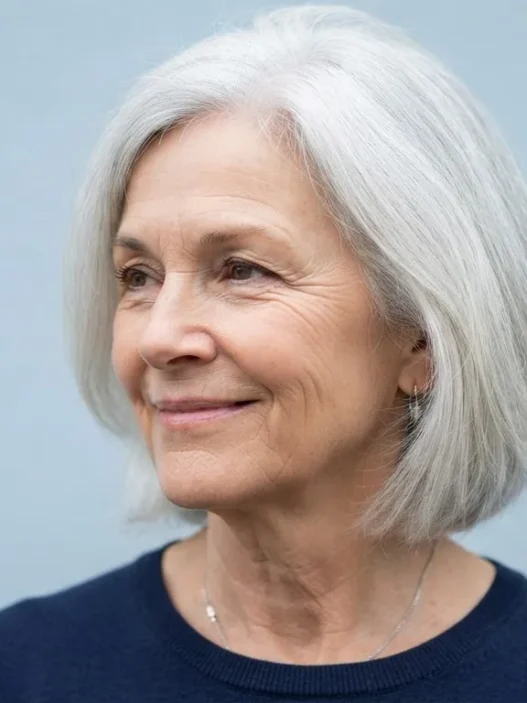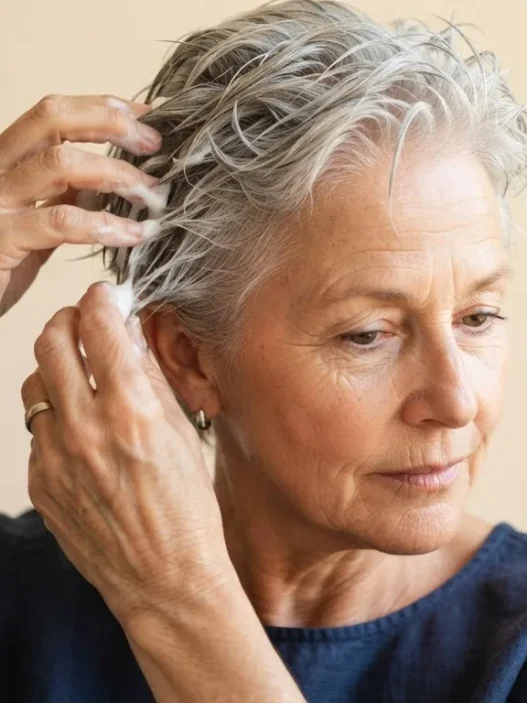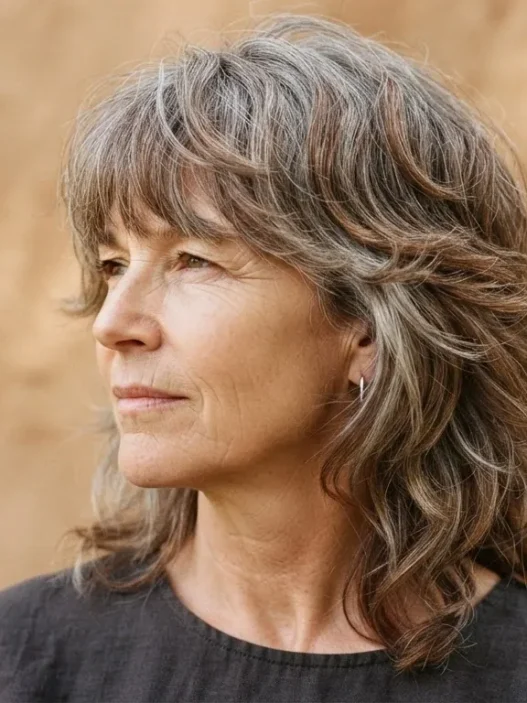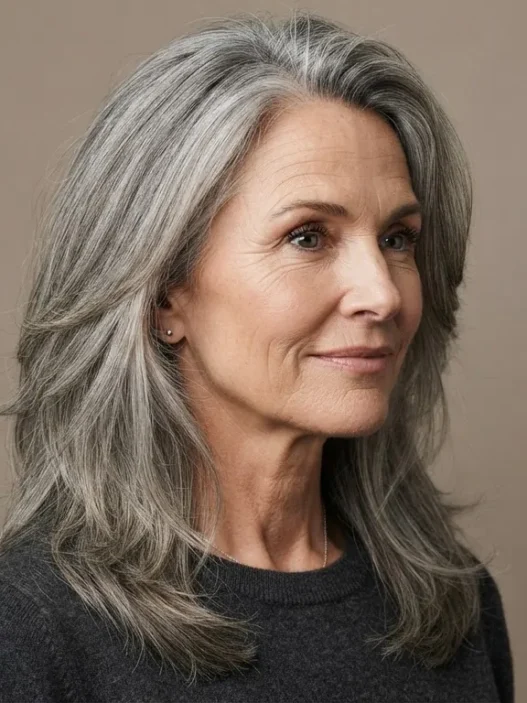







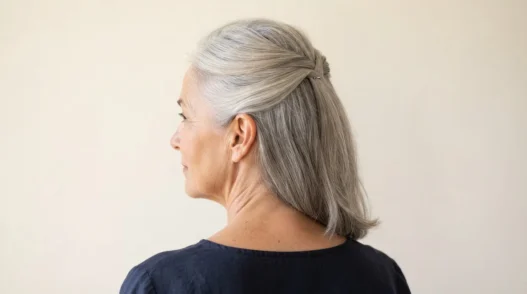
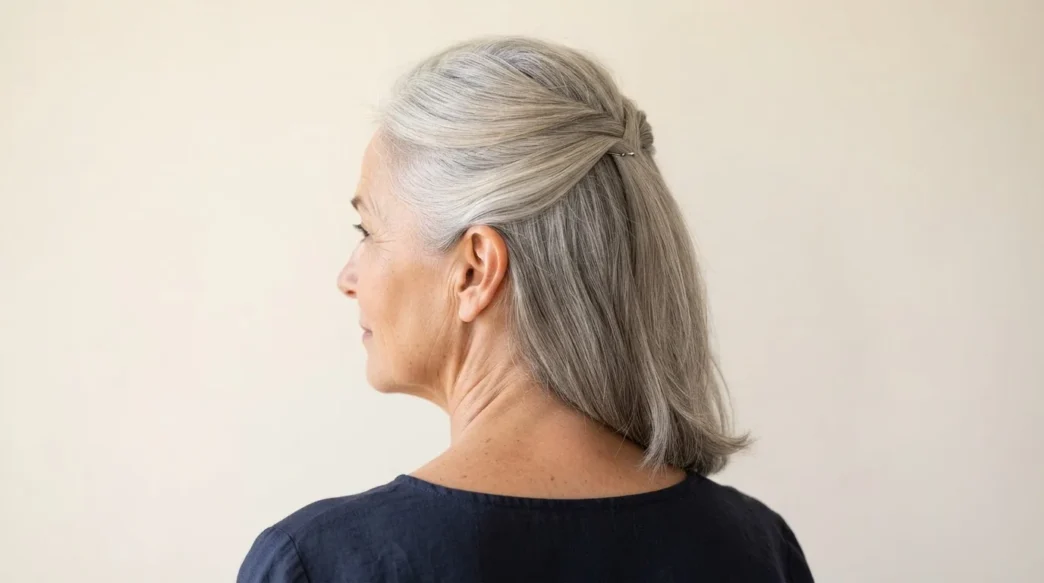
I came to the half-up style late — probably around 45, when I finally admitted that a full updo looked too severe on me and a full blowout lasted about forty minutes before losing all its lift. The half-up sits in this genuinely useful middle ground: the crown is elevated, the nape is uncovered, and you still look like you made a decision. That last part matters more than people say. What I didn’t expect was how many ways there are to do it — and how differently each one behaves on hair that’s gone finer, or silver, or both.
Below are nine half up hairstyles I’ve watched work (and occasionally fail) on real women in their 40s, 50s, and 60s. I’ve described each one by how it’s actually constructed, not just by what it looks like in a flattering photo. That’s the part your stylist actually needs to hear.
9 Half-Up Options — Jump to the One That Fits Your Hair
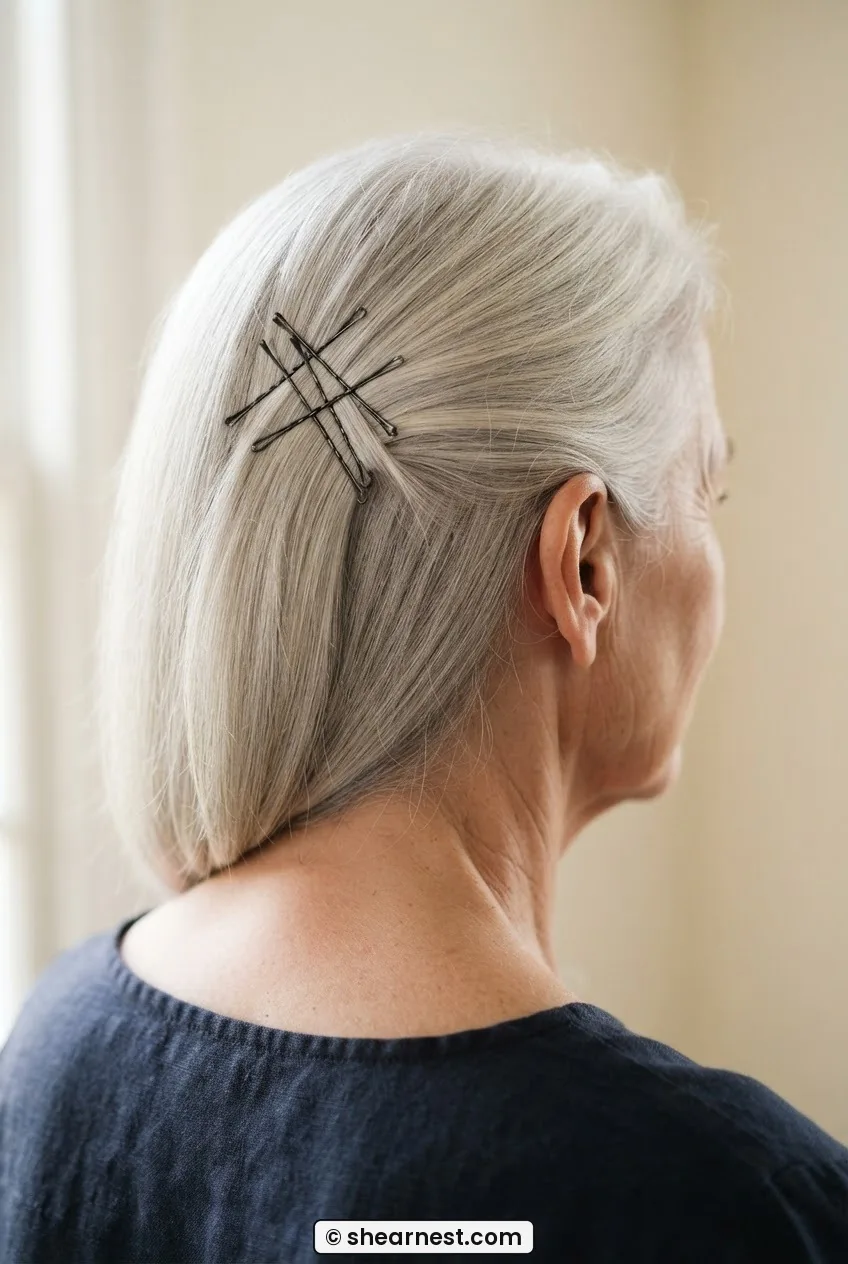
1. The Flat-Pin Crown Section
This is the most architectural of the nine. A triangular section is lifted from the very top of the head — roughly from temple to temple and back to the crown — then pinned flat to the skull with two or three fine-gauge bobby pins crossed in an X. No product, no backcombing. The lift comes entirely from the angle of the pin, not from teasing the root, which is why it’s kind to fine hair.
It suits women with good density at the crown and a natural part they already like. Thin hair at the temples can look slightly exposed in this one — if that’s you, skip to number three. Between appointments it needs nothing. The pins don’t move if you set them correctly, and you’re not fighting a ponytail elastic that creates a dent.
At the chair: ask for a triangular section to be demonstrated on you so you know where the base points sit on your own head. Once you see it, you can replicate it yourself in under two minutes.
2. The Twisted Back Panel
Take the top third of the hair — not a triangle, but a horizontal panel from one side to the other — and twist it once, firmly, before pinning it at center-back with a single large barrette or a flat pin. The twist creates a rope-like ridge across the back of the head that reads as intentional even when your hair has zero wave to it.
This one photographs beautifully from the back, which is why it keeps turning up as a wedding-guest option. It works particularly well on mid-length hair — the kind that sits between chin and collarbone — because the twist shortens the appearance of the lifted section and keeps the weight balanced. On longer hair the panel can feel heavy and start to slip by mid-afternoon.
Upkeep is low. One pin, one move. If you’re exploring mother of the bride hair updos after 50, this is the style I’d start the conversation with — it’s relaxed enough to not look like a helmet but still reads as dressed.
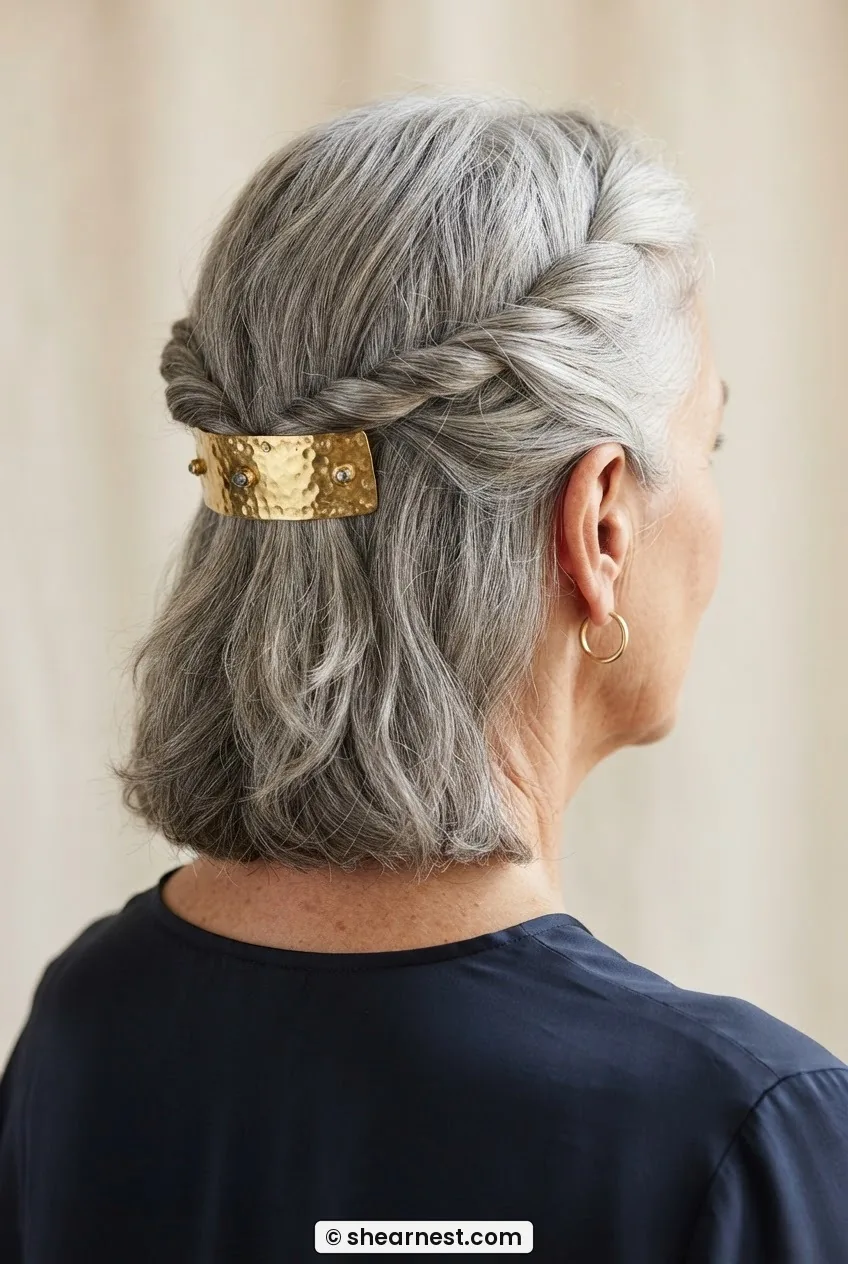
3. The Clip-Caught Puff
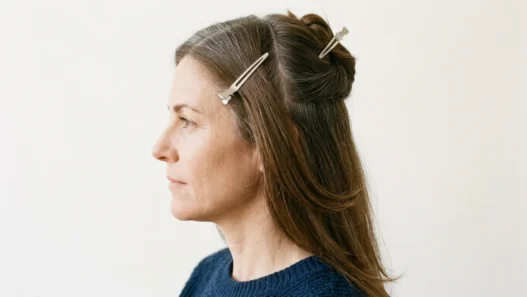
Here the crown section is gathered loosely — not pulled taut — and caught with a wide jaw clip or a banana clip placed horizontally at the back of the head. The hair isn’t pressed flat. It’s allowed to puff slightly above the clip, which is where the volume lives. That puff is the whole point.
I love this one for fine or thinning hair because the looseness disguises how much (or how little) hair is actually in the clip. You’re not stretching anything flat and revealing the scalp — you’re creating a soft mass that reads as full. Look at how she’s wearing hers in this photo — that puff above the clip is doing real work at the crown without any backcombing underneath.
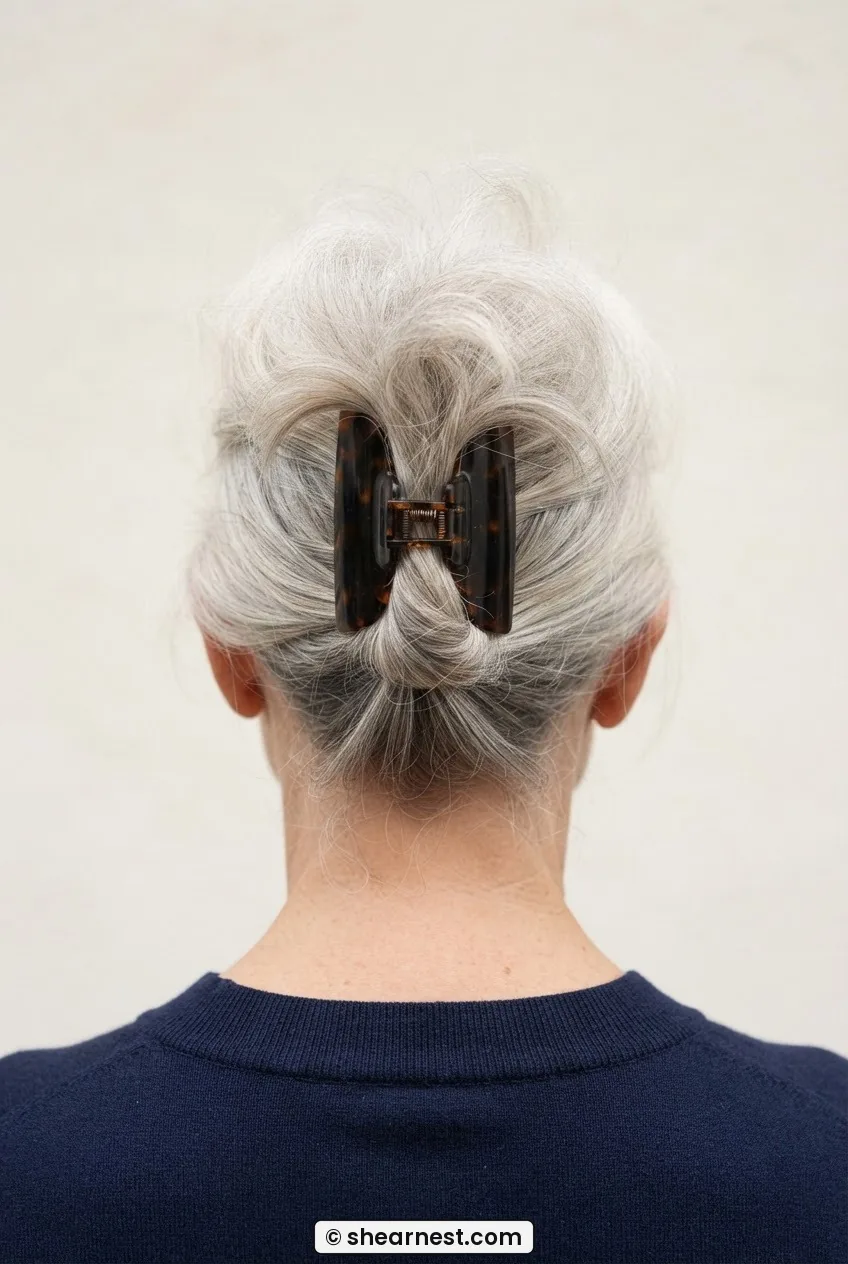
Between appointments, the clip can be swapped out for different finishes — tortoiseshell for day, lacquered black for evening. Ask your stylist to show you the right clip width for your section size, because a clip that’s too narrow will let the section sag on either side.
4. The Braided Hinge
A small three-strand braid is worked from one temple, pulled across the back of the crown, and pinned on the opposite side. It acts as a hinge — the rest of the half-up section is gathered underneath it and sits anchored against the braid rather than being held by its own pin. The construction means the weight is distributed horizontally rather than pulling straight down from one point, which is much kinder to fine hair at the roots.
Suits wavy and lightly textured hair best. On completely straight fine hair the braid can look slightly stiff unless the stylist leaves the braid loops intentionally loose. This one takes about five minutes to do at home once you’ve had it demonstrated. The braid itself can be tight or deliberately messy — the looser version reads more casual, the tighter version more polished.
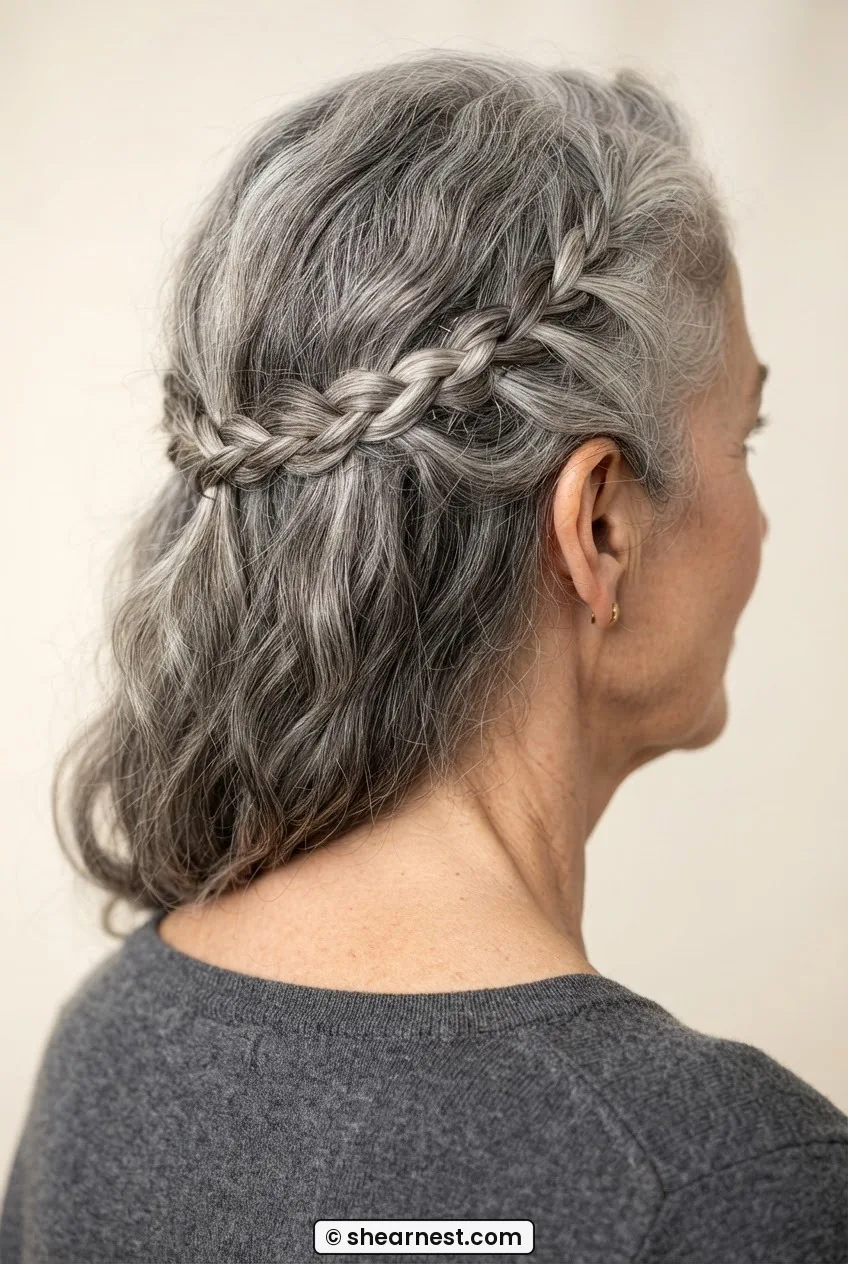
My personal pick is this one — the braided hinge. I’ve worn it to three events in the past year and had someone ask how long it took me each time. The answer was seven minutes, but I let them think it was longer.
5. The Softened French Pull-Through
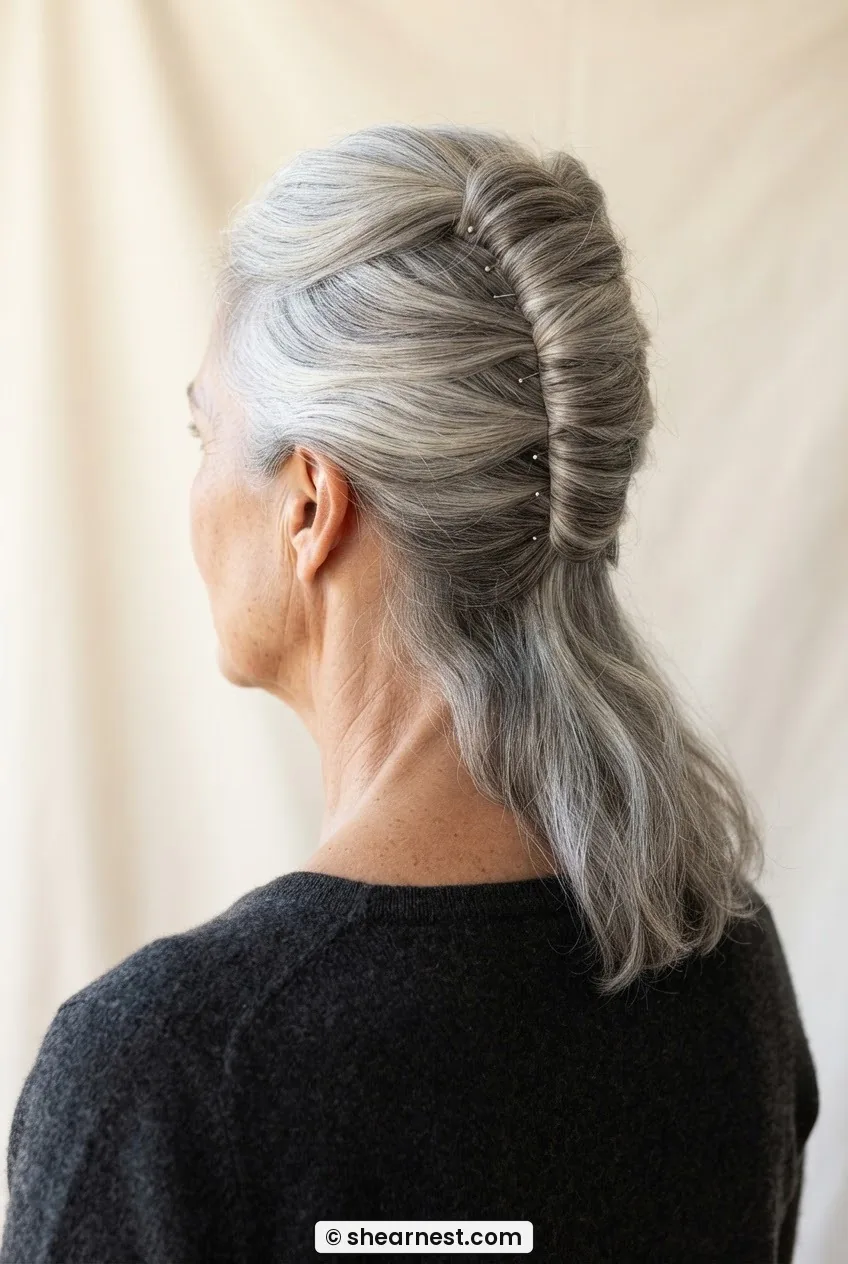
This is a variation on the French twist logic, but stopped halfway. The back panel of hair is gathered, folded upward, and tucked — but only the top half. The bottom half hangs free. What you get is a vertical roll at the back of the head that transitions into loose hair below the occipital bone. It’s more structured than most half-ups here and requires a few pins to hold the fold.
It genuinely suits thick, coarse hair better than anything else on this list. That’s the hair type where most half-up styles struggle to stay put — there’s too much of it, and it pulls everything down. The vertical fold gives it somewhere to go. Thinner hair can attempt it with a texturizing spray applied first, but expect to re-pin at least once during a long evening. If you have the hair type for this, you can explore more structured options in this breakdown of the low updo method for mature hair — a lot of the same principles apply.
6. The One-Piece Claw Hold
Exactly what it sounds like. One oversized claw clip. The crown section — or sometimes almost all of the hair above the ear — is gathered, twisted once or twice, and clamped. No pins, no elastics, no technique beyond the grip of the clip itself.
I know this sounds too simple to be worth naming separately, but the difference between this looking effortless and looking accidental is entirely in the clip size and the height of the placement. A clip that’s too small for your hair volume leaves wisps falling out within the hour. A clip placed too low reads as an afterthought. Placed at the crown — genuinely at the crown, not the nape — and sized generously, this is a legitimate style. She’s got hers placed high enough in this photo that you can see the lift it creates. That height is the whole thing.
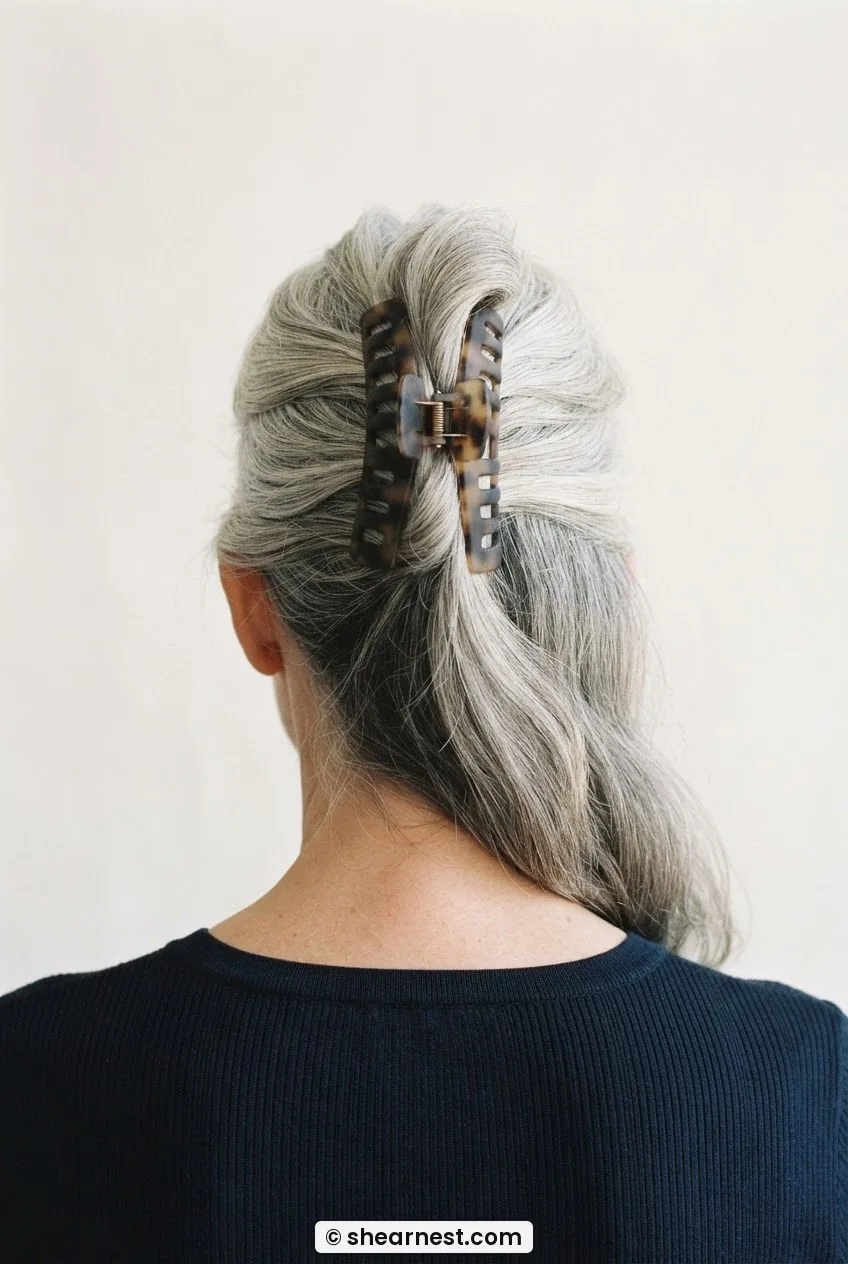
Zero upkeep between salon appointments. The clip does all the work. Best on medium-density hair; very fine hair may not grip the clip well and very thick hair may pop it open.
7. The Wrap-and-Pin
The top section is gathered, then wrapped — the gathered hair is coiled around its own base once — and the tail is tucked under and pinned. Unlike a full bun, the coil here is flat and low-profile. It sits close to the head, adds no height at the crown, and relies on the wrap to create texture and interest rather than volume.
This one is genuinely better for women who don’t want crown lift — maybe because their hair already has natural volume there, or because they prefer a sleeker look. It’s also the most formal of the nine. Understanding how texture and density shift on hair for older women over 50 helps here — coarser, grayer hair often wraps beautifully because it has more grip than fine hair does.
At the chair, ask your stylist to show you how tight to coil it. Too loose and it unravels; too tight and it looks strained at the roots.
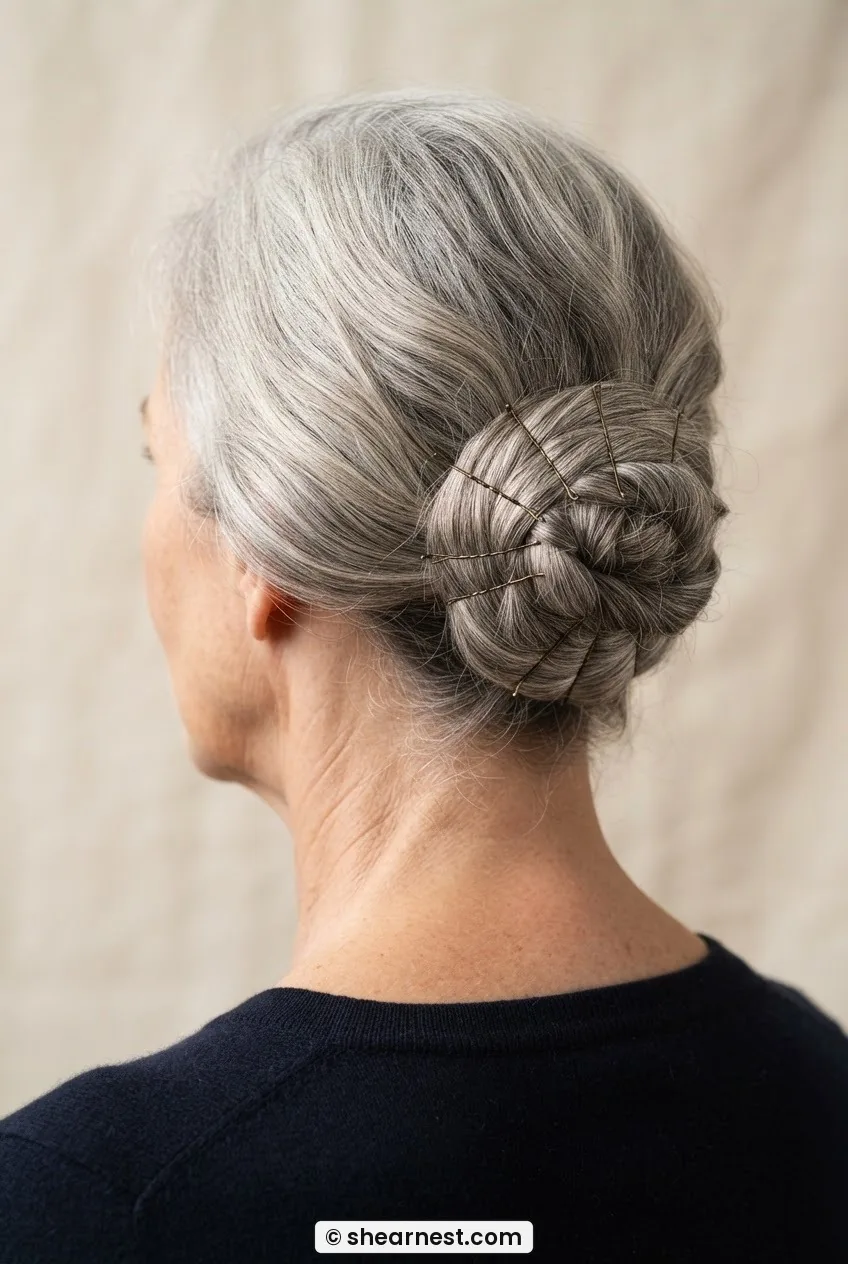
8. The Simple Elastic Half-Tail
A half-up half-down ponytail. The top section pulled back and secured with a small elastic, a ribbon, or a fabric tie. This is the one people mean when they search for something simple, and it earns its place on this list because done well, it’s genuinely elegant. Done carelessly, it looks like you ran out of time.
The construction detail that separates elegant from hasty: the section pulled back should sit at the occipital ridge — that bony bump at the back of the head — not below it and not above it. Too high and it reads as a sporty ponytail from the 1990s. Too low and it pulls the sides of the face downward. Right at the ridge, it creates a natural arc that follows the skull shape. The tension and placement matter far more than the tie you use.
Suits almost every hair type. The easiest one to do at home. Also the easiest one to get slightly wrong — so spend a minute in front of a hand mirror checking the back height before you leave the house.
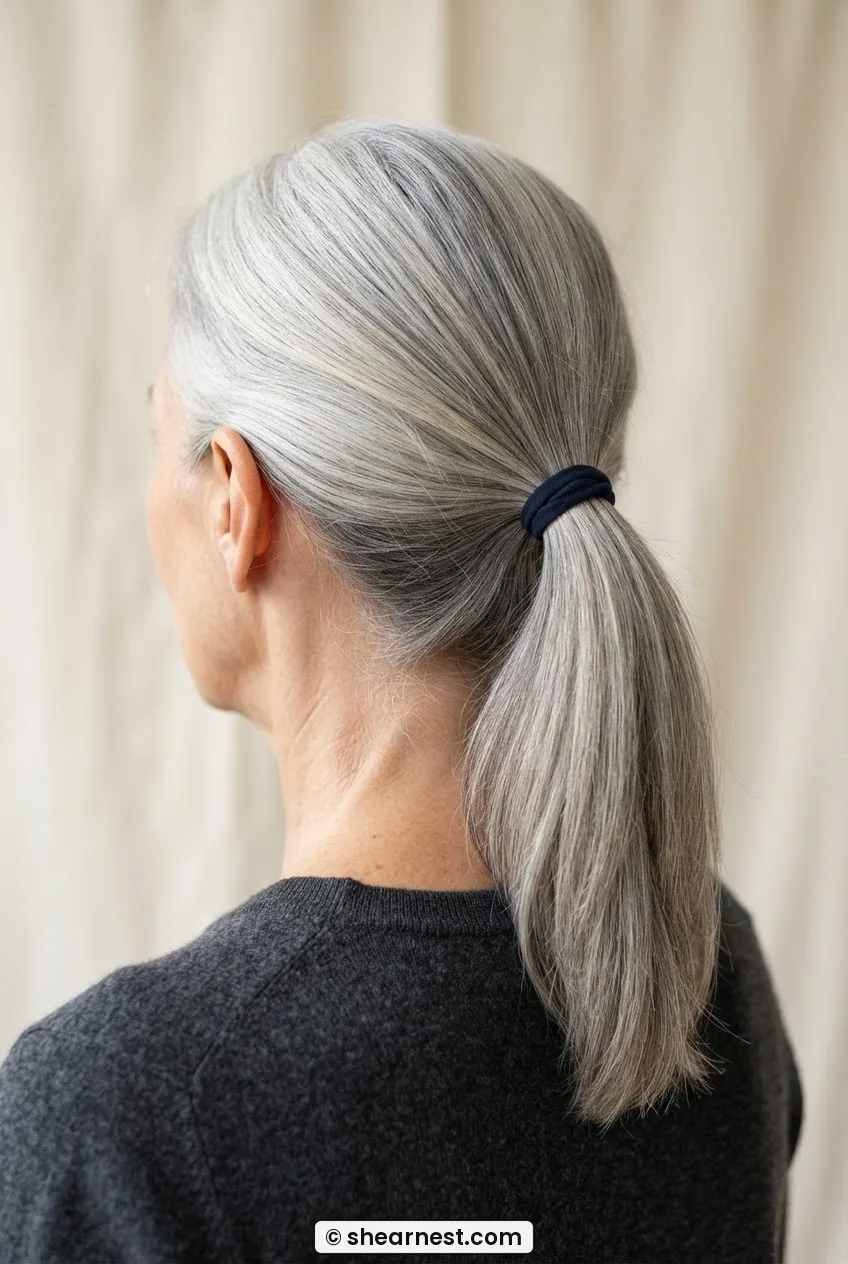
9. The Gathered Knot
The crown section is gathered, knotted once — like the first move in tying a shoelace — and the resulting loop is pinned rather than pulled through fully. What stays visible is a soft knot at the back of the head, looser than a chignon, with texture that comes from the knot itself rather than from any styling product.
This is my second favorite for occasions. It reads as deliberate without looking like you spent forty minutes on it, and it holds remarkably well on silver hair specifically — possibly because silver hair tends to have a slightly coarser texture that grips itself. If you’re thinking about high bun variations for women over 50, the gathered knot is a useful halfway point — it borrows the polish without the formality.
Thick hair benefits from a light-hold spray applied to the section before knotting, so the knot doesn’t loosen as the day goes on. Fine hair should keep it loose — a tight knot on fine hair shows the scalp through the twist. Ask your stylist to do it once while you watch the placement in a mirror, and you’ll have it from that point on.
What to Actually Say at the Chair
The stylist needs to know two things: where you want the weight to sit (crown lift versus flat and sleek), and how long the style needs to last without your hands near it. A style built for two hours at a lunch will not survive a twelve-hour wedding day without reinforcement. Both pieces of information change which of the nine options above your stylist will reach for — and which pins they’ll use to build it.
It’s also worth mentioning your hair type specifically. The construction differences between fine and thick hair mean that the same style instruction produces very different results depending on what you’re working with. Naming your texture — fine, coarse, silver, chemically colored — gives your stylist permission to adapt the method rather than copying a photo exactly.
If you’re still working out which styles make sense for your specific hair changes, the piece on hair styles for women over 70 and what actually changes covers the structural shifts that affect styling decisions across the decades — useful context even if you’re in your 50s or 60s.
Quick Answers
Does a half-up style work on very short hair?
It depends on what ‘short’ means for you. If you have enough length at the crown to gather a section — roughly two inches or more — then options one, three, and six on this list will work. Anything shorter than that and you’re really looking at a pinned-back side section rather than a true half-up.
Which of these holds longest without re-pinning?
The braided hinge (number four) and the flat-pin crown section (number one) both hold well all day because the structure doesn’t rely on friction alone. The claw clip options are the most likely to shift, especially if your hair is very fine or very freshly washed.
Do I need to blow-dry my hair first for any of these?
Not necessarily, but hair that has been dried with some tension at the root holds a half-up style more cleanly than air-dried hair, which tends to be flatter and more slippery. If you prefer to air-dry, add a light volumizing spray to the crown section while damp — it gives the hair enough grip to stay put.
Will a half-up style work for a wedding or formal event?
Absolutely — numbers two, five, seven, and nine on this list read as occasion-appropriate without looking stiff. If you want something tested specifically for that context, my longer guide on mother of the bride hair updos after 50 covers which styles hold for eight-plus hours and which ones need a backup plan.
Nine is a lot of options for something that looks this simple — but that’s exactly the point. A half-up hairstyle isn’t a single thing. It’s a category with real variation inside it, and which version is right for you comes down to your hair type, your occasion, and honestly how much patience you have on a Tuesday morning. Pick the construction that fits your real life, not the one that looked best in an editorial. Those two things are occasionally the same, but not always.